Showing posts with label Climate Change. Show all posts

April 3, 2017

A war on climate is also a war on our health

Climate change and human health are inextricably linked. Stepping back from the fight against climate change will also be a massive loss for public health.


The Clean Power Plan has been a big win for health. According to the EPA, cutting exposure to particle pollution under the CPP would have averted up to 3,600 premature deaths, 90,000 asthma attacks in children, and 1,700 heart attacks each year.
According to the Global Burden of Disease project, more than 5 million people die worldwide each year because of air pollution — and emissions from coal-fired plants are a major risk factor here. It's one reason why health experts have been pushing policymakers to rapidly phase out of coal.
For miners, the immediate health risks include black lung disease and scarring of the lung tissue. But the pollutants emitted when coal is processed — including sulfur dioxide, particulate matter, nitrogen oxides, and mercury — have much more far-reaching effects on many more people.
In one large study involving 450,000 Americans followed between 1982 and 2004, researchers found that increased exposure to the particles in fossil fuel emissions increased the risk of death from heart disease — and particles from coal burning were five times more damaging than other similar particles.
Reducing emissions from coal-fired power plants also makes it easier to breathe. Over the past 30 years, the percentage of Americans with asthma has more than doubled, and climate change has been a significant driver of that trend. Air pollution triggers asthma attacks, contributing to lung abnormalities, particularly in the developing pulmonary systems of children.
Our health needs to be a big part of the discussion. It is not just the fate of our planet that is at risk if we scale back our commitment to fighting climate change. 
[Vox]

Climate Change, Water and Trees

The benefits of moving beyond our focus on energy.

When we talk about "energy", certainly in terms of policy, we usually mean what fuels our cars and heats our homes. Let's look at energy in a very basic sense, as in what happens when sunlight meets the ground. Say you have pavement, or land marked by degraded, exposed soil – the condition of much of the world's surface. When the sun beams down on that bare soil, solar energy is absorbed; it becomes sensible heat, or heat you can feel. Now amble over to a nice meadow, or well-managed rangeland with a thick carpet of grasses. Here solar energy touches down on plants that are transpiring. The solar heat is dispersed and becomes latent heat, embodied in water vapour, to be condensed and released as rain.

Climate is not a function of one sole metric; it is not a single story. And this is where we find opportunities.
When faced with an environmental predicament, it can be useful to inquire as to how nature has approached similar scenarios. For instance, in the case of wildfire, one can ask what processes used to keep that landscape hydrated and therefore resilient to fire. We learn that in the American west, beavers created wetlands and acted as "shock absorbers" that minimised fire risks. And when we ask what maintains our climate, the answer is water.
Were it not for the blanket of water vapour that buffers the Earth, our planet would be too cold to inhabit. The phase changes of water – from solid to liquid to gas, and back – represent an extraordinary transfer of heat. According to Australian microbiologist Walter Jehne, water-based processes in the atmosphere and the oceans, over land and across ice, govern some 95% of Earth's natural heat dynamics. It is the sheer immensity of water's role in climate that led scientists to conclude that humans could not have interfered with it. And yet, once we understand how water works – and how water intersects with factors we can influence, such as land use and plant cover – we can help to restore the processes that sustain the heat and energy balance, and therefore sustain our climate.
A deforested area in the middle of the Amazon jungle. Photograph: Raphael Alves/AFP/Getty Image
Peter Andrews, a farmer and author in Australia, made a statement that has stuck with me: "Plants manage water. And in managing water, they manage heat." Worth noting: we have de-vegetated a quarter of the planet – including destroying most of our natural forests.
Every square metre of Earth's surface receives an average of 342 watts of solar energy a day. Because of how humans have altered the environment, we now radiate back about 339 watts per square metre – a difference of less than 1%. If we managed our ecology better, how might we make up that three-watt differential? How about if we had a lot more plant cover and a lot less bare ground?

Peak Precipitation increasing in a Warming World

A new study by Dr. Guiling Wang from the University of Connecticut and her colleagues has made a surprising discovery. Their work was just published in Nature Climate Change. They report that the peak temperature (the temperature where maximum precipitation occurs) is increasing in a warming world. 
The idea is shown in the sketch below. Details vary with location but, as the world warms, there is a shift from one curve to the next, from left to right. The result is a shift such that more intense precipitation occurs at higher temperatures in future, while the drop-off moves to even higher temperatures. 
 Increasing precipitation curves as the world warms 
In my state, we have had four 1000-year floods since the year 2000! Two years ago, Minneapolis, Minnesota had such flooding that people were literally fishing in the streets as lakes and streams overflowed and fish escaped the banks. 
It falls upon city planners and engineers to design infrastructure that is more able to accommodate heavy rains and manage water. This means designing river containment areas or flood plains, reinforcing buildings and houses, and increasing the capacity of storm drainage, just to name a few. 


August 25, 2015

The Beloved in Nature

My sister helped to create this incredibly beautiful and uplifting short video. I hope you are as moved by it as I was and encourage your friends and family members to watch it as well... 

University of San Francisco's President Father Paul Fitzgerald speaks about climate change, ending with a call to action: simplify and consume less. Incorporates many of the concepts in Pope Francis' Encyclical on climate change.


The video was produced by Green Impact.


October 21, 2014

Hottest September on Record

Last month was the warmest September the globe has experienced since record-keeping began in 1880, according to the National Oceanic and Atmospheric Administration.

NOAA also found that September's record-breaking average temperature continues a trend set this year: average temperatures for the January through September 2014 period tied with 1998 and 2010 as the warmest January-September on record. [Climate Progress]


May 15, 2014

We're Running Out of Time

Here's the key finding [from the  Intergovernmental Panel on Climate Change's most recent report]: The world has only about 15 years left in which to begin to bend the emissions curve downward. Otherwise, the costs of last-minute fixes will be overwhelming. 

"We cannot afford to lose another decade," says Ottmar Edenhofer, a German economist and co-chairman of the committee that wrote the report. "If we lose another decade, it becomes extremely costly to achieve climate stabilization."

[NYTimes]


April 17, 2014

Top 5 Actions from IPCC's Climate Action Plan

The world's top scientists have released the most important projections and action plan for global warming in history. Here are the top five actions from the IPCC Climate Action Plan. 

1) The world must phase-out of fossil fuels and a shift to clean energy investments. While global emissions are still growing, some modern and innovative economies have already beaten the trend - moving from dirty fossil fuels to renewable energies, proving it can be done
2) Substantial shifts in annual investment flows between 2010 and 2029 are required, i.e. cuts in fossil fuel investments of USD 30 billion per year, while more than doubling the investment in renewables. Delaying mitigation action now implies higher costs of action later, says the IPCC, while the co-benefits of actions taken now can outweigh their costs.
3) Urban areas are expected to triple by 2030. This is directly relevant to climate change as urban areas account for roughly 70% of global energy use and global energy-related CO2 emissions. Since much of this urban infrastructure will be built in the next 20 years, there is massive potential for smart infrastructure choices, combined with low energy codes in new buildings, retrofits of the existing housing stock and more widespread use of already existing technologies and efficiencies.
4) Forests, agriculture, and land use could become a net CO2 sink by the end of the century. They currently account for about quarter of global greenhouse gas emissions, and could become a net CO2 sink due to successful afforestation efforts, reduced deforestation, and better agricultural practices.
5) Energy efficiency offers massive potential and multiple benefits, as well as the need for improved demand side management. Of course it's vital to produce energy in a more sustainable way, but saving energy in the first place and avoiding unnecessary waste is even better.
And the report includes a surprisingly hopeful note:
The IPCC is clear that we can still keep global warming below the danger-threshold of 2 degrees C compared to pre-industrial levels, if we make bold and quick decisions towards deeper and faster cuts in emissions. Even keeping warming to 1.5 degrees C, as many developing nations have been urging, is not ruled out. 
Faith communities can make a difference. Did you know religious institutions are among the world's largest landholders? Faith communities own 7-8% of the habitable land surface of the planet, including 5% of commercially run forests worldwide.

November 5, 2013

White House: It's Time For Adaptation and Resilience

The White House is expected to take new steps to help society adapt to global warming, an acknowledgment that worldwide efforts to control emissions will be inadequate to head off big climatic shifts.

White House aides said President Obama would sign an executive order on Friday morning directing federal agencies to make it easier for states and communities to build resilience against storms, droughts and other weather extremes. For instance, when federal money is being spent on projects like roads, bridges, flood control and many others, the plan would encourage greater attention to the likely climate conditions of the future, which might require making the structures stronger or larger.


May 19, 2013

Why Climate Change is not an Environmental Issue

Washington Monthly's Ryan Louis Cooper makes the case that climate change is not an environmental issue. Interesting perspective.

He does a good job underlining the reality that while climate change does concern the environment, it concerns a lot more than that:
"I'm not saying that climate change isn't a major threat to the current biosphere (it definitely is), nor am I saying that other species don't have moral worth, but the point is that there is not some kind of easy trade-off between humanity and nature. When we dammed Glen Canyon to create Lake Powell, it was a monstrous crime against all that is sacred, but we humans continued to live our lives largely without disruption. Climate change, on the other hand, is a direct, existential threat to the biosphere AND all of human civilization. It's just too big to fit into something like environmentalism."

May 14, 2013

Climate Change Milestone - 400ppm

For homo sapiens, the epochal news is that CO2 levels in the atmosphere have exceeded 400 parts per million for the first time in human existence, which continues a 200-year rise that is now accelerating. [Guardian]
Hourly readings above 400ppm have been recorded six times in the last week, and on occasion, at observatories in the high Arctic. The Mauna Loa station, sited at 3,400 m and far away from major pollution sources in the Pacific Ocean, has been monitoring levels for more than 50 years and is considered the gold standard.
"I wish it weren't true but it looks like the world is going to blow through the 400 ppm level without losing a beat. At this pace we'll hit 450 ppm within a few decades," said Ralph Keeling, a geologist with the Scripps Institution of Oceanography which operates the Hawaiian observatory.

Keeling Curve

March 22, 2013

A Convenient Excuse

You may have read that the Boston Phoenix shut down. They've been publishing some of the best stuff on climate change recently - including this incredible piece from last fall titled - 'A Convenient Excuse' on the great Climate Silence from the mainstream media. 

Wen Stephenson is an outstanding writer. I highly encourage you to read it. It may not be available a week from now. 

Prominently mentioned in the article are Bill McKibben and Kerry Emanuel (a Lexington resident and expert on hurricanes). 

Wen Stephenson raises important questions about why the press' response to climate change has been so inadequate. This is an important message for each and every one of us to consider. 


Jesuit response to climate change

It is well worth reading this Jesuit response to climate - "Healing A Broken World" - in light of the fact that the Catholic Church now has a Jesuit Pope. 

Here are a few thoughts and recommendations from the report. 

"The ecological crisis challenges our faith. It is the entire world, the one God put in the hands of humankind to keep and preserve, which is in real danger of destruction. This is not an apocalyptical message but a very real possibility if we stick to our 'business as usual' attitude and refuse to act with conviction and strength. The first victim is the Earth, the resources that it contains and that are destined for present and future generations. Special mention must be made first of biodiversity, the loss of which is irreversible and dramatically reduces the richness of nature. Next among the victims are the poorest of this world."

"It is difficult not to be confronted also by the implications of greed and over-consumption; by the use (and misuse) of natural resources and land; by the incredible generation of waste."

Recommendations:

Sustainability should be a primary goal of our individual and collective activities.

Promote prayerful discernment in our communities and institutions to examine our lifestyle and work environment.

Generate environmental awareness to influence public policy both at the national and international level.

Seek deeper communion with creation and learning from other religious traditions.

Examine our pattern and levels of consumption and firmly commit ourselves to a reduction in consumption.

Make the establishing of right (just) relationships with creation a theme of prayer in our communities.

March 9, 2013

Earth warming 50 times faster than the last 5,000 years of cooling

Temperature change over past 11,300 years (in blue, via Science, 2013) plus projected warming 
this century on humanity's current emissions path (in red, via recent literature).
An extraordinary look at 11,300 years of temperature data confirms that the global temperature is higher than at anytime in the last 4,000 years and is warming 50 times faster than the rate of cooling over the last 5,000 years. [Climate Progress] [Science]


February 10, 2013

Al Gore's Talk at Harvard

I attended Al Gore's talk at Harvard on Wednesday night and thought you might appreciate hearing some of his thoughts. 

Gore delivered the inaugural Paul R. Epstein Memorial Lecture in honor of the former Harvard Medical School instructor and authority on the links between climate change and human health. Paul had agreed to speak at an event we were organizing here in Lexington on the impacts of coal power on human health, but he had to cancel due to health reasons shortly before he passed away. 

Gore talked about how many people are not yet associating human health with climate change. Many of us may be aware that climate change is expanding the range of insects like mosquitos that bear diseases like Dengue Fever and West Nile Virus. But he said that many people are not aware that climate change is also expanding the range of micro-organisms themselves and as a result we are seeing an increase in many diseases. 

Gore compared the climate crisis to 19th-century cholera epidemics that have been traced to water sources that had been infected by dumping sewage into the streets. Society now treats the sky as an "open sewer," pumping carbon waste into the air much as it used to dump bodily waste into waterways, and with the same results. People are getting sick. 

"We're using the atmosphere as an open sewer. It's functionally insane. It traps heat," Gore said. "A lot of communities experience one in 100-year events, one in 1,000-year events … every few years."

85% of all the energy we use comes from fossil fuels. We dump 90 million tons of heat trapping CO2 into the atmosphere everyday. And we are trapping 400,000 Hiroshima bombs worth of heat in the atmosphere every day. 

We have 4% more water vapor in the atmosphere than we did 30 years ago, this results in bigger floods, bigger downpours and higher energy storms. 

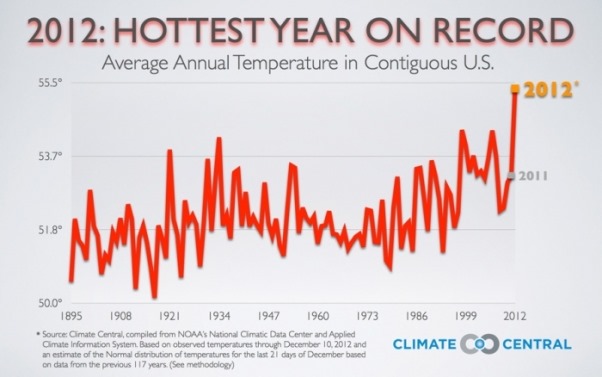
We just saw 32" of rain in Queensland Australia over a 4 day period. 2012 was the hottest year on record for the US. We had $110 billion dollars of climate damage. Unprecedented wildfires, drought covering over 60% of the country, worst outbreak of West Nile Virus, half the polar ice cap disappeared, the jet stream affected and of course Superstorm Sandy. 

We need to think about the impact of these events. Congress wonders if we have enough money to help those who have been affected. What about the 20 million people who were displaced by flooding in Pakistan - an already unstable nuclear power? 

He said that even with all these events - there was not one question from the media about climate change in any of the presidential debates. "That is pathetic! The media is not playing a responsible role in our society." 

He was asked what he thought about mining the tar sands for oil. "Well junkies will shoot up between their toes after the veins in their arms and legs give out." 

When asked about the divestment movement - "If I were a student, I would support what you're doing," Gore told the students at Harvard. "But if I were a board member I would do what I did when we took up the Apartheid issue. This is an opportunity for learning and the raising of awareness, for the discussion of sustainable capitalism."

He said that our democracy had been hacked through the influence of money. That representatives now have to spend 5 hours a day begging for money to fund their re-election campaigns. It can't help but influence their behavior. 

He said capitalism needed to be reformed as it was causing wild disruptions in the economy. When we agreed to give mortgages to 7.5 million people who couldn't afford to pay them, it caused a global run on the banks because those subprime assets weren't valued properly. 

He said that the fossil fuel industry now has $23 trillion dollars worth of artificially priced subprime fossil fuel assets that the fossil fuel companies are telling their stockholders they intend to burn. He said - we can't, we just can't burn those assets if we want to have a livable climate. We need to begin to value those assets wisely. This is another bubble. 

He believes the value of those fossil fuel reserves will collapse over the long-term time frames that pension funds are managed for. 

Finally - we need to stop measuring our economic success in terms of GDP - because there are so many externalities it just doesn't measure. 

There are negative externalities like:


  Pollution
  Degradation of the natural environment

But there are positive externalities that aren't measured either - like: 
  Education
  Investment in Infrastructure

Finally he said one of the most destructive negative externalities is the distribution of income. 

He mentioned that Sam Walton started an amazing company - WalMart. But when Sam passed away - 6 members of his family inherited his money. Gore said that those 6 people now have more money than all of the bottom 100 million people in America combined. 


December 29, 2012

An Odometer Moment for Global Warming - 333 months and counting


For those keeping score, we just passed the 333rd consecutive month of global temperatures above the 20th-century average.
November 2012 was the fifth-warmest November since records began in 1880, the National Oceanic and Atmospheric Administration said in its monthly climate report. The agency calculated that the 10 warmest Novembers on record have all occurred within the past 12 years.
The last time global temperatures came in below the 20th-century average for the month of November was in 1976, and the last time any month came in below the average was February 1985.

December 13, 2012

2012: Hottest, Most Extreme Year on Record


The year-to-date period of January – November has been by far the warmest such period on record for the contiguous U.S.–a remarkable 1.0°F above the previous record.

The NCDC’s Climate Extremes Index (CEI), which “tracks the percentage area of the contiguous U.S. experiencing top-10% and bottom-10% extremes in temperature, precipitation, and drought,” reports it has also been the most extreme January to November period on record.

November 3, 2012

What role did climate change play in Hurricane Sandy?

Kevin Trenbreth has the answer - published in The Scientist on October 31, 2012
Sandy started as an ordinary hurricane, feeding on the warm surface waters of the Atlantic Ocean for fuel.  The warm moist air spirals into the storm, and as moisture rains out, it provides the heat needed to drive the storm clouds.  By the time Sandy made landfall on Monday evening, it had become an extratropical cyclone with some tropical storm characteristics: a lot of active thunderstorms but no eye.  This transformation came about as a winter storm that had dumped snow in Colorado late last week merged with Sandy to form a hybrid storm that was also able to feed on the mid-latitude temperature contrasts.  The resulting storm—double the size of a normal hurricane—spread hurricane force winds over a huge area of the United States as it made landfall.   Meanwhile an extensive easterly wind fetch had already resulted in piled up sea waters along the Atlantic coast.  This, in addition to the high tide, a favorable moon phase, and exceedingly low pressure, brought a record-setting storm surge that reached over 13 feet in lower Manhattan and coastal New Jersey.  This perfect combination led to coastal erosion, massive flooding, and extensive wind damage that caused billions in dollars of damage.
In many ways, Sandy resulted from the chance alignment of several factors associated with the weather. A human influence was also present, however.  Storms typically reach out and grab available moisture from a region 3 to 5 times the rainfall radius of the storm itself, allowing it to make such prodigious amounts of rain. The sea surface temperatures just before the storm were some 5°F above the 30-year average, or "normal," for this time of year over a 500 mile swath off the coastline from the Carolinas to Canada, and 1°F of this is very likely a direct result of global warming.  With every degree F rise in temperatures, the atmosphere can hold 4 percent more moisture. Thus, Sandy was able to pull in more moisture, fueling a stronger storm and magnifying the amount of rainfall by as much as 5 to 10 percent compared with conditions more than 40 years ago.  Heavy rainfall and widespread flooding are a consequence.  Climate change has also led to the continual rise in sea levels—currently at a rate of just over a foot per century—as a result of melting land ice (especially glaciers and Greenland) and the expanding warming ocean, providing a higher base level from which the storm surge operates. 
These physical factors associated with human influences on climate likely contribute to more intense and possibly slightly bigger storms with heavier rainfalls.  But this is very hard to prove because of the naturally large variability among storms.  This variability also makes it impossible to prove there is no human influence.  Instead, it is important to recognize that we have a "new normal," whereby the environment in which all storms form is simply different than it was just a few decades ago.  Global climate change has contributed to the higher sea surface and sub-surface ocean temperatures, a warmer and moister atmosphere above the ocean, higher water levels around the globe, and perhaps more precipitation in storms.
The super storm Sandy follows on the heels of Isaac earlier this year and Irene last year, both of which also produced widespread flooding as further evidence of the increased water vapor in the atmosphere associated with warmer oceans. Active hurricane seasons in the North Atlantic since 1994 have so far peaked with three category 5 hurricanes in the record breaking 2005 season, one of which was Katrina.  As human-induced effects through increases in heat-trapping gases in the atmosphere continue, still warmer oceans and higher sea levels are guaranteed. As Mark Twain said in the late 19th century, "Everybody talks about the weather, but nobody does anything about it." Now humans are changing the weather, and nobody does anything about it! As we have seen this year, whether from drought, heat waves and wild fires, or super storms, there is a cost to not taking action to slow climate change, and we are experiencing this now.
From New Zealand, Kevin Trenberth is a distinguished senior scientist at the National Center for Atmospheric Research (NCAR). He has been heavily engaged in the World Climate Research Programme (WCRP), where he currently chairs the Global Energy and Water Exchanges (GEWEX) program, as well as the Intergovernmental Panel on Climate Change, for which he shared the Nobel Peace Prize in 2007.

August 20, 2012

Sixty Years of Climate Change


This bell curve graph shows how the distribution of Northern Hemisphere summer temperature anomalies has shifted toward an increase in hot summers. The seasonal mean temperature for the entire base period of 1951-1980 is plotted at the top of the bell curve. Decreasing in frequency to the right are what are defined as "hot" anomalies (between 1 and 2 standard deviations from the norm), "very hot" anomalies (between 2 and 3 standard deviations) and "extremely hot" anomalies (greater than 3 standard deviations). The anomalies fall off to the left in mirror-image categories of "cold, "very cold" and "extremely cold." The range between the .43 and -.43 standard deviation marks represent "normal" temperatures.

As the graph moves forward in time, the bell curve shifts to the right, representing an increase in the frequency of the various hot anomalies. It also gets wider and shorter, representing a wider range of temperature extremes. As the graph moves beyond 1980, the temperatures are still compared to the seasonal mean of the 1951-1980 base period, so that as it reaches the 21st century, there is a far greater frequency of temperatures that once fell 3 standard deviations beyond the mean.

As the graphic indicates, each bell curve shown through the time series represents the distribution of anomalies over an 11-year period.

August 19, 2012

James Hansen on Extreme Weather

This is a very interesting article showing how our climate is changing based on data from the Northern Hemisphere. 

It shows quite clearly how the small changes in the average temperature we've already seen have increased extreme events by more than 10x.