Showing posts with label Ethanol. Show all posts

August 31, 2012

When will we stop burning our food?


Drought is driving corn prices to record levels as we continue to burn 40% of our corn in our engines. 

Researchers at Texas A&M University have estimated that diverting corn to make ethanol forces Americans to pay $40 billion a year in higher food prices. On top of that, it costs taxpayers $1.78 in subsidies for each gallon of gasoline that corn-based ethanol replaces, according to the Congressional Budget Office.

The damage is far-reaching. Beef and pork producers are slaughtering their stocks at a record pace to cut use of corn feed that costs two-thirds more than three months ago. U.S. cattle herds next year are forecast to be the smallest since 1952, a guarantee of more expensive food in years to come.

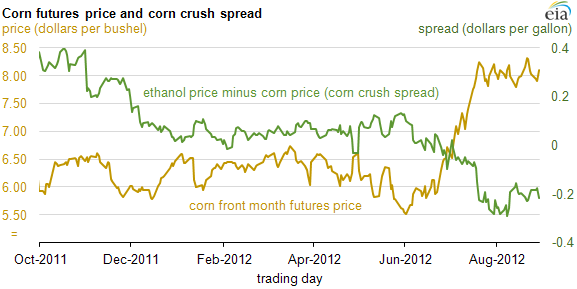
On top of that, by some calculations, ethanol takes more energy to produce than it yields, negating the environmental benefits. Now the EIA says that ethanol is taking more money to produce than it yields. 
More than 150 House members and 25 U.S. senators, as well as the director general of the United Nations Food and Agricultural Organization, have asked Obama to temporarily suspend the ethanol mandate in order to check the rise in food prices. He should listen to them, and Congress should permanently roll back the ethanol requirements.

July 14, 2012

Food or Fuel?


The nearly 5 billion bushels of corn that will be cordoned off to create ethanol could feed 412 million people for an entire year. Instead, it will be turned into 13.5 billion gallons of corn ethanol. 

February 2, 2010

Latest Statistics on Ethanol & Food

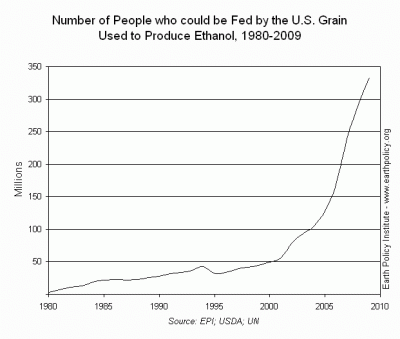
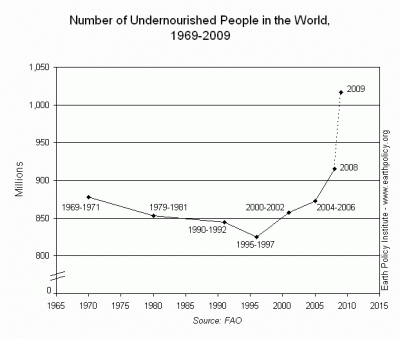
The results of our subsidies for corn ethanol production can be seen in the graphs below.

 Number of People who could be Fed by the U.S. Grain Used to Produce Ethanol, 1980-2009

Number of Undernourished People in the World,  1969-2009

March 8, 2008

Diet for a Small Planet

I've been reading about the links between hunger and the health of our planet from Lester Brown's new book.
Plan B 3.0 Mobilizing to Save Civilization

The Himalayan glaciers that feed the rivers that irrigate the rice fields of China and the wheat fields of India are disappearing at a rate of 7% a year. - "Global Outlook for Ice and Snow" UN Environment Program Nairobi 2007

Crop withering heat waves have lowered grain harvests in recent years. Record high temperatures in 2002 and 2003 reduced the world grain output 90 million tons or 5% below actual grain consumption.

In 7 of the last 8 years, world grain production has fallen short of consumption. Worldwide carryover stocks are at their lowest level in 34 years. We are eating into our grain reserves.

Worldwide grain production peaked at 342 kilograms per capita in 1984, dropping to 302 kilograms per capita in 2006.

When oil prices rose above $60 a barrel, corn based distillation of ethanol became enormously profitable. The United States is now the largest producer of Ethanol, eclipsing Brazil in 2005.

81 million tons of the 2007 US corn harvest was used to create ethanol. This is 20% of US corn production. It generated less than 4% of US automotive fuel.

The grain required to fill one 25 gallon tank with ethanol will feed one person for a year.

The 2 billion poorest people in the world use 60% of their income to buy food.

As the share of US corn production dedicated to ethanol increases, it is driving up food prices around the world. In September 2007, the price of corn was nearly double what it was 2 years before. Wheat prices have also doubled and soybean prices have gone up by more than 50%.

Four years ago a study by Runge and Senauer of UMinn projected the number of hungy people decreasing to 625 milllion in 2025. An update of those projections, based on the massive diversion of grain to ethanol production, shows the number of hungry and mal-nourished people rising to 1.2 billion by 2025.

The competition between the owners of the world's 860 million automobiles and the 2 billion poorest people in the world is uncharted territory for humanity.

Although there are no alternatives to food for people, there are alternatives to using ethanol for vehicles. For example, the 4% of automotive fuel supplied using ethanol could be replaced several times over by increased fuel efficiency standards. And at a cost much lower than we are spending on ethanol.