Showing posts with label Drought. Show all posts

December 11, 2012

Drought Endures into Winter

Arid topsoil from a farm in Kansas, still one of the states hardest hit by the drought. - John Moore

Summer swelter has given way to frost, but nearly two-thirds of the country remains in a drought - 

Just over a quarter of the nation's wheat crop, planted mostly in September and October, was in poor or very poor condition, according to a report released last week by the United States Department of Agriculture. Those are the worst conditions since the department began keeping records in 1986, said Brad Rippey, a meteorologist with the department.

Perhaps the most unusual sign of the nagging drought is the 3,700-acre wildfire raging in the Rocky Mountains in northern Colorado.
The fire in Estes Park, which started in October from an illegal campfire, is burning at altitudes of 8,000 to 10,000 feet, on peaks that should be covered in snow right now.
The fire more than doubled in size on Saturday morning after 70 mile-per-hour winds swept through the area, forcing the evacuation of about 600 residences nearby, said Don Ferguson, a spokesman for the National Park Service.

August 31, 2012

Drought Devastates Corn Crops

The insurance industry faces its biggest ever loss in agriculture as the worst drought to hit the US in more than half a century devastates the country's multibillion-dollar corn and soybean crops, triggering large claims. [CNN]

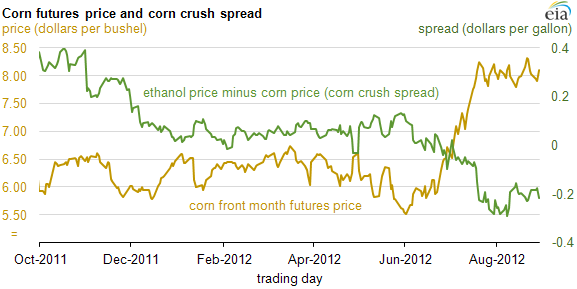
Higher corn costs, brought on by the most severe U.S. drought in 56 years, has renewed attention on the 5-year-old federal mandate to increase the amount of ethanol blended into gasoline. [Tulsa World]


When will we stop burning our food?


Drought is driving corn prices to record levels as we continue to burn 40% of our corn in our engines. 

Researchers at Texas A&M University have estimated that diverting corn to make ethanol forces Americans to pay $40 billion a year in higher food prices. On top of that, it costs taxpayers $1.78 in subsidies for each gallon of gasoline that corn-based ethanol replaces, according to the Congressional Budget Office.

The damage is far-reaching. Beef and pork producers are slaughtering their stocks at a record pace to cut use of corn feed that costs two-thirds more than three months ago. U.S. cattle herds next year are forecast to be the smallest since 1952, a guarantee of more expensive food in years to come.

On top of that, by some calculations, ethanol takes more energy to produce than it yields, negating the environmental benefits. Now the EIA says that ethanol is taking more money to produce than it yields. 
More than 150 House members and 25 U.S. senators, as well as the director general of the United Nations Food and Agricultural Organization, have asked Obama to temporarily suspend the ethanol mandate in order to check the rise in food prices. He should listen to them, and Congress should permanently roll back the ethanol requirements.

August 9, 2012

Extreme Drought


The percentage of the earth's land surface covered by extreme heat in the summer has soared in recent decades, from less than 1 percent in the years before 1980 to as much as 13 percent in recent years, according to a new scientific paper.

The change is so drastic, the paper says, that scientists can claim with near certainty that events like theTexas heat wave last year, the Russian heat wave of 2010 and the European heat wave of 2003 would not have happened without the planetary warming caused by the human release of greenhouse gases. [NY Times]

Rising Temperature - Rising Food Prices

By Lester R. Brown

Over the last two months, the price of corn has been climbing. On July 19th, it exceeded $8 per bushel for the first time, taking the world into a new food price terrain. 

This is not the way it was supposed to be. This spring, farmers planted a record 96 million acres of corn. An early spring got the crop off to a great start, leading the U.S. Department of Agriculture (USDA) to project the largest corn harvest in history.

On June 12th, the USDA projected the U.S. harvest would hit a record 376 million tons. But the drought conditions that had initially been confined to the country's southwest began to spread and intensify. In its next monthly report on July 11th, the USDA reduced its projection to 329 million tons of corn, down by 12 percent or 47 million tons. This was a huge drop in only one month. Yet in the end the actual decline may be closer to 30 percent, or roughly 100 million tons—double the USDA estimated drop. (See data.)

Because the USDA is overestimating the harvest, it is underestimating the food price rise in the months ahead. Even as corn prices are setting all-time highs, so too are soybean prices, putting still more upward pressure on food prices.