May 15, 2014

Climate Change and Food Production

A friend recently asked whether more carbon dioxide in the atmosphere would help plants grow faster. If you've wondered the same thing, the research is clear that hotter and dryer conditions have dire impacts on plant growth. 

Plants die quite rapidly without water - and we are seeing unprecedented drought conditions throughout much of California and the Midwest where most of our food is grown - as a result of climate change. 

Even with adequate water supplies, high temperatures cause significant yield loss in our crops. And extended heat waves of 4 days or longer, even with irrigation, devastate crop yields. 

It was 102 degrees on Sunday May 4th in Kansas where we grow a lot of our wheat. This is the hottest temperature ever recorded during the month of May in Kansas.  Those record temperatures continued 4 days through Wednesday. The earliest we've previously seen 102 degrees in Kansas was on June 2nd - almost a whole month later.


On top of that, Kansas has had the least rain this season since the time records have been kept - even worse than during the Dust Bowl year of 1936. 

The combination of the worst drought in recorded history and the hottest temperatures in recorded history are happening right now - in Kansas - America's bread basket. This is not some distant future effect of climate change. This is now. This is affecting our food supply this year. 

For those who like peer reviewed data, here is some academic research to back up the common sense understanding that the combination of scorching heat waves and drought conditions result in crop failures. 

Productivity of wheat and other crop species falls markedly at high temperatures. All stages of development are sensitive to temperature. It is the main factor controlling the rate of crop development. [FAO - Food and Agriculture Organization]
For every 1°C rise in temperature, there is a depression in grain yield by 8 to 10%, mediated through 5 to 6% fewer grains and 3 to 4% smaller grain weight.
While a linear model works well to describe wheat development as long as temperatures remain within 10 to 30°C, a non-linear model as in Figure 6.1 [shown below] is needed to describe development when a crop is exposed to extreme temperature stress.
This chart shows growth rate of wheat vs temperature. Wheat grows well till temperatures reach 86 degrees F, after that productivity falls off rapidly. 

With high night temperatures (in the 70s or 80s) more of the sugars produced by photosynthesis during the day are lost; less is available to fill developing kernels or seeds, thereby lowering potential grain yield. Low night temperatures during grain fill have been associated with some of Ohio's highest corn yields in past years. Soybean plants subjected to a night temperature of 85°F resulted in a 10% yield loss.  Corn subjected to 85°F at night experienced grain yield reductions of 40%. [Ohio State University


Our food future in 5 alarming charts

This chart shows crop yields in Illinois and Indiana compared to maximum temperature between 1980 and 2007. 


Different crops respond differently to temperature increases. The following chart assumes that adequate water supply and soil moisture will be maintained - a precarious assumption as we'll see in the next few charts. 


California - our vegetable basket is increasingly strapped for irrigation water. 


Dry spells are on the rise - This map shows the predicted increase in the maximum number of consecutive dry days, comparing the 1971-2000 period to projections for 2070-90.


Heavy downpours are washing huge amounts of top soil away. Known as "gully erosion," this kind of soil loss currently isn't counted in the US Department of Agriculture's rosy erosion numbers, which hold that Iowa's soils are holding steady. But Richard Cruse, an agronomist and the director of Iowa State University's Iowa Water Center, has found Iowa's soils are currently disappearing at a rate as much as 16 times faster than the natural regeneration. According to the National Assessment, days of heavy rain have increased steadily in Iowa over the past two decades, and will continue doing so.


April 17, 2014

Extreme Weather Causing 10x more power outages


new report from Climate Central has found that major power outages have increased ten times over since the early 1980s — and extreme weather is by far the biggest culprit.


Climate Central broke down the trends in weather-related versus non-weather-related outages. The two diverge sharply beginning around 2000, as the former goes up while the latter remains almost unchanged.


Who says solar power can't supply energy at night?

The team behind the Solar Impulse project - a mission to fly around the world in a plane powered only by the sun - has revealed the plane in which the pilots will make their attempt. 

Its predecessor, Solar Impulse 1, has already been flown across America, and stored sufficient power in its batteries to fly all night.

With a wingspan of 72m (236ft), Solar Impulse 2 is the wider than a Boeing 747, but weighs about the same as a large car.
Its wings are covered in 18,000 solar cells to convert sunlight into electricity to power its motor and to store in its batteries. Here's a link to the story and a fun quote. 
"I mean, the airplane can fly a month. The question is, What can the pilot do?" 
"So we have a sustainable airplane in terms of energy; we need to develop a sustainable pilot now."


High-Low Pressure 'Dipole' Froze the East and Baked the West

A new study in Geophysical Research Letters (subs. req'd) takes the warming link to the California drought and the frigid east coast to the next level of understanding. 
The research provides "evidence connecting the amplified wind patterns, consisting of a strong high pressure in the West and a deep low pressure in the East [labeled a 'dipole'], to global warming." Researchers have "uncovered evidence that can trace the amplification of the dipole to human influences."

Top 5 Actions from IPCC's Climate Action Plan

The world's top scientists have released the most important projections and action plan for global warming in history. Here are the top five actions from the IPCC Climate Action Plan. 

1) The world must phase-out of fossil fuels and a shift to clean energy investments. While global emissions are still growing, some modern and innovative economies have already beaten the trend - moving from dirty fossil fuels to renewable energies, proving it can be done
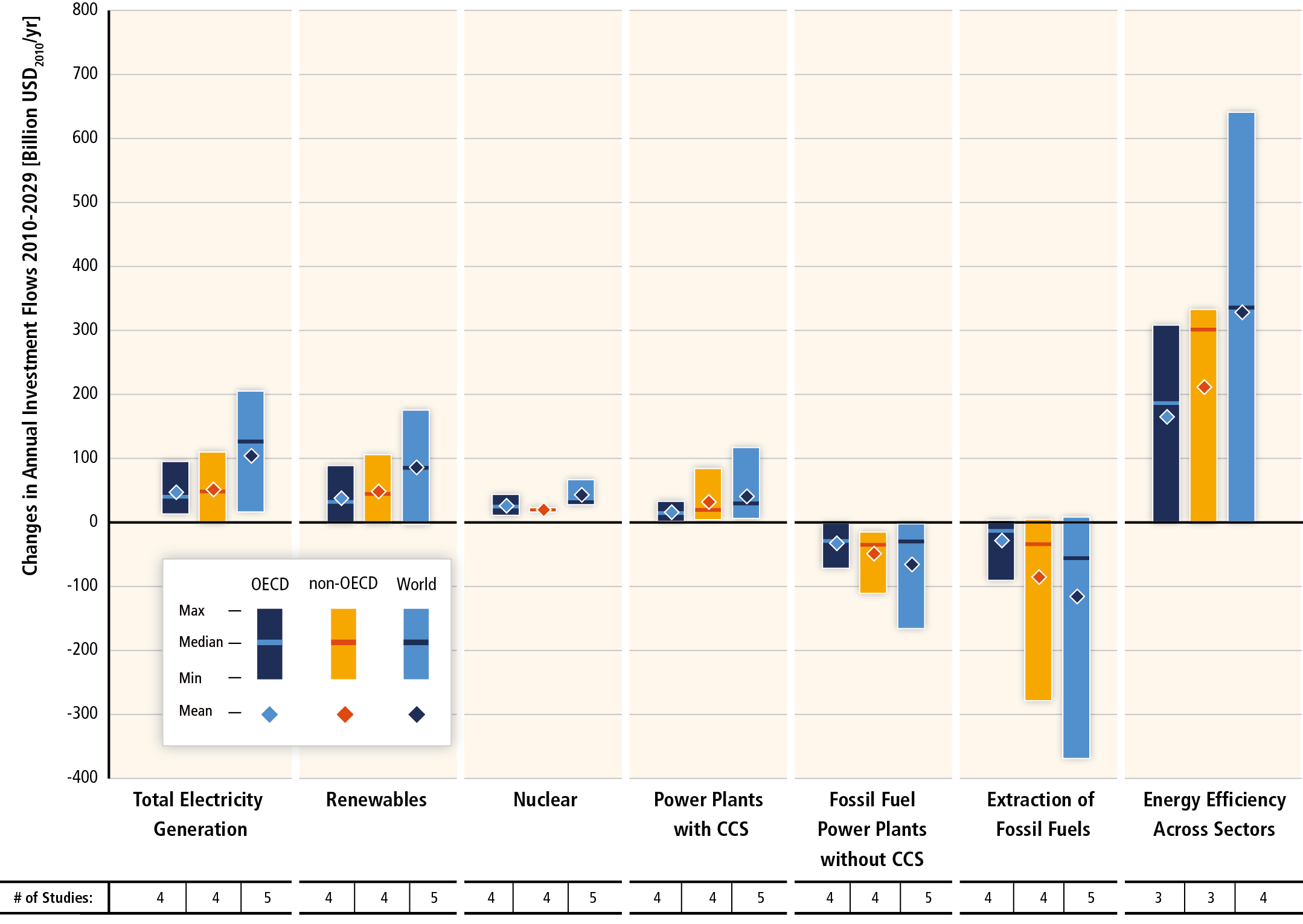
2) Substantial shifts in annual investment flows between 2010 and 2029 are required, i.e. cuts in fossil fuel investments of USD 30 billion per year, while more than doubling the investment in renewables. Delaying mitigation action now implies higher costs of action later, says the IPCC, while the co-benefits of actions taken now can outweigh their costs.
3) Urban areas are expected to triple by 2030. This is directly relevant to climate change as urban areas account for roughly 70% of global energy use and global energy-related CO2 emissions. Since much of this urban infrastructure will be built in the next 20 years, there is massive potential for smart infrastructure choices, combined with low energy codes in new buildings, retrofits of the existing housing stock and more widespread use of already existing technologies and efficiencies.
4) Forests, agriculture, and land use could become a net CO2 sink by the end of the century. They currently account for about quarter of global greenhouse gas emissions, and could become a net CO2 sink due to successful afforestation efforts, reduced deforestation, and better agricultural practices.
5) Energy efficiency offers massive potential and multiple benefits, as well as the need for improved demand side management. Of course it's vital to produce energy in a more sustainable way, but saving energy in the first place and avoiding unnecessary waste is even better.
And the report includes a surprisingly hopeful note:
The IPCC is clear that we can still keep global warming below the danger-threshold of 2 degrees C compared to pre-industrial levels, if we make bold and quick decisions towards deeper and faster cuts in emissions. Even keeping warming to 1.5 degrees C, as many developing nations have been urging, is not ruled out. 
Faith communities can make a difference. Did you know religious institutions are among the world's largest landholders? Faith communities own 7-8% of the habitable land surface of the planet, including 5% of commercially run forests worldwide.

IPCC: It won't cost much to save the planet

IPCC finds that ambitious climate actions will only cost 0.06% per year! 

The IPCC adopted their Working Group III report focused on emission reductions on April 12, 2014. The report consists of 16 chapters with more than 2,000 pages. It was written by 235 authors from 58 countries and reviewed externally by 900 experts. They also released the 33-page Summary for Policymakers (SPM) that was approved by all 193 countries. 

This report has two very important new offerings.
The 2-degree limit
For the first time, a detailed analysis was performed of how the 2-degree limit can be kept, based on over 1,200 future projections (scenarios) by a variety of different energy-economy computer models. The analysis is not just about the 2-degree guardrail in the strict sense but evaluates the entire space between 1.5 degrees Celsius, a limit demanded by small island states, and a 4-degree world. The scenarios show a variety of pathways, characterized by different costs, risks and co-benefits. The result is a table with about 60 entries that translates the requirements for limiting global warming to below 2-degrees into concrete numbers for cumulative emissions and emission reductions required by 2050 and 2100. This is accompanied by a detailed table showing the costs for these future pathways.


The IPCC represents the costs as consumption losses as compared to a hypothetical 'business-as-usual' case. The table does not only show the median of all scenarios, but also the spread among the models. It turns out that the costs appear to be moderate in the medium-term until 2030 and 2050. 

Translated into reduction of growth rate, these numbers are actually quite low. Ambitious climate protection would cost only 0.06 percentage points of growth each year. This means that instead of a growth rate of about 2% per year, we would see a growth rate of 1.94% per year. Thus economic growth would merely continue at a slightly slower pace. [Real Climate]