Showing posts with label Solar Power. Show all posts

April 3, 2017

Should Massachusetts go 100% renewable


The Boston Globe recently ran two editorials with the pros and cons of going 100% renewable and then asked their readers to vote. 

Here are the results. Going 100% renewable won by almost 12 to 1! 


​


Business Insider discovers solar's potential

There's one simple fact that may just change your thoughts on renewable power.

In a single hour, the amount of power from the sun that strikes the Earth is more than the entire world consumes in a year.

Each hour 430 quintillion Joules of energy from the sun hits the Earth. 
That's 430 with 18 zeroes after it!
In comparison, the total amount of energy that all humans use in a year is about 410 quintillion Joules.
Clearly, we have a source of virtually unlimited clean energy in the form of solar power. 


March 29, 2017

Carbon free electricity by 2060?

Carbon emissions from electricity generation could be reduced 70 percent by 2050, and eliminated entirely by 2060, according to a new report by the International Renewable Energy Agency (IRENA).

So what would it take to eliminate carbon emissions entirely from making electricity?
The answer is both efficiency improvements, and a shift of the generating mix into renewable energy.
The study claims 90 percent of that reduction could be achieved by expanding renewable-energy use and by making improvements in a wide range of energy efficiency measures.

Renewable energy already accounts for 24 percent of global power generation, and 16 percent of "primary energy supply," according to IRENA.
But to achieve the necessary reduction in carbon emissions, it would need to reach 80 percent of power generation and 65 percent of primary energy supply by 2050, the study said.

Electric cars would need to become the "predominant" vehicle type by 2050, for example, and recharge largely on electricity from renewable sources.

Buildings would also need to convert to all-electric power, with a focus on energy efficiency.
A total of 2 billion buildings would need to be renovated or built new to achieve the necessary carbon-emissions reductions, according to the study.

Elimination of carbon emissions from electricity generation is a worthy and important goal, but environmentalists and policymakers will have to work hard to achieve the fairly ambitious goals called for by this study.


Tesla's Solar+Storage project saves money in Hawaii

  • Tesla has completed its fully dispatchable solar+storage project on the Hawaiian island of Kauai, installing a 13 MW, 52 MWh project that will help boost the amount of renewables.

  • Under the terms of a 20-year contract, KauaŹ»i Island Utility Cooperative will pay Tesla $0.139 / kWh—less than the current cost of oil, according to the utility.  
  • The project will allow solar energy to be delivered at night, helping the utility toward its goal to deliver 100% renewable power in line with Hawaii's renewable goal of 100% by 2045.

March 4, 2017

Rooftop solar could generate 47% of Massachusetts' electricity

According to a report released by the National Renewable Energy Laboratory (NREL), rooftop solar could meet almost half of Massachusetts' electricity demand.  For the country as a whole, NREL estimates a suitable rooftop potential for solar of 1,118 GW. The 1,432 TWh this amount of solar could produce, would account for 39% of the United States' electricity sales. 

The study by the National Renewable Energy Laboratory says the estimated potential from rooftop solar has been revised upwards by more than 80 per cent since the last study in 2008, mostly because of improvements of module efficiencies, building availability and solar modelling.

A cluster of New England states – Maine, Vermont, Rhode Island, New Hampshire, Connecticut and Massachusetts –  could generate more than 45 per cent of their electricity needs from rooftop solar PV, despite the below-average solar resource of these states.
The NREL says a common feature of the top six states – in terms of potential PV generation as a percentage of total sales –  is the significantly below-average household consumption, suggesting the role an energy-efficient residential sector could play in achieving a high penetration of energy from rooftop PV.
NREL points out that these are not predictions, just potential output. But is also says its own estimates could be highly conservative.
Firstly, it uses an average module efficiency of 16 per cent, when most modern rooftop systems have efficiencies of around 20 per cent. If this average was used, it would lift its figures by around 25 per cent, meaning that rooftop solar had the potential to meet half the country's electricity demand (and nearly 90 per cent in California).
The study also did not take into account the enormous potential of ground-mounted solar, nor did it take into account other installations such as car parks, or integrating solar PV into building facades. Only 26 per cent of "small  rooftop" spaces were considered suitable for solar PV.


October 7, 2015

Solar and Wind Just Passed Another Turning Point

Bloomberg Business: It has never made less sense to build fossil fuel power plants

Wind power is now the cheapest electricity to produce in both Germany and the U.K., even without government subsidies, according to a new analysis by Bloomberg New Energy Finance (BNEF).

But that's less interesting than what just happened in the U.S. 

One of the major strengths of fossil fuel power plants is that they can command very high and predictable capacity factors. The average U.S. natural gas plant, for example, might produce about 70 percent of its potential (falling short of 100 percent because of seasonal demand and maintenance). But that's what's changing, and it's a big deal. 

For the first time, widespread adoption of renewables is effectively lowering the capacity factor for fossil fuels. That's because once a solar or wind project is built, the marginal cost of the electricity it produces is pretty much zero—free electricity—while coal and gas plants require more fuel for every new watt produced. If you're a power company with a choice, [or a regulator in California,] you choose the free stuff every time. 

It's a self-reinforcing cycle. As more renewables are installed, coal and natural gas plants are used less. As coal and gas are used less, the cost of using them to generate electricity goes up. As the cost of coal and gas power rises, more renewables will be installed. 

"Renewables are really becoming cost-competitive, and they're competing more directly with fossil fuels," said BNEF analyst Luke Mills. "We're seeing the utilization rate of fossil fuels wear away." 

The shift illustrates a serious new risk for power companies planning to invest in coal or natural-gas plants. Historically, a high capacity factor has been a fixed input in the cost calculation. But now anyone contemplating a billion-dollar power plant with an anticipated lifespan of decades must consider the possibility that as time goes on, the plant will be used less than when its doors first open. 

"...onshore wind and solar PV are both now much more competitive against the established generation technologies than would have seemed possible only five or 10 years ago," said Luke Mills, analyst at BNEF.  


March 1, 2015

Solar is a better investment than the stock market


A study by the NC Clean Energy Technology Center finds that in all but 4 of the 50 largest cities in the U.S., installing a fully-financed 5 kilowatt solar panel system makes more financial sense than investing in a popular stock market index fund. 
Further, the same system would beat the costs of buying energy from local utilities in 42 of those 50 cities. 
Boston is ranked the #2 city for solar in the country for immediate average monthly savings, the relative value of investing in solar versus the S&P 500, and the levelized cost of solar energy compared to local utility rates. 
"(S)olar is now ...a real opportunity for anyone looking to take greater control over their monthly utility bills and make a long-term, relatively low-risk investment," concludes the study which was done under funding by the U.S. Department of Energy.
Looking at the levelized cost of energy for solar PV systems (the average cost per kilowatt over the expected 25-year life span), the NC Clean Energy Technology Center's study found that nearly 21 million homeowners in 42 of the nation's largest cities would save money with financed solar systems over getting their power from the grid.
For average homeowners, the study concludes, "solar can generate both significant monthly savings and long-term investment value, and not infrequently, cost less than energy from some of America's largest electric utilities."

October 21, 2014

Germans love renewable energy

Germans generated one third of their electricity from renewable sources while enjoying unusually low wholesale electricity rates, one of the most reliable electricity grids in the world with only 16 minutes of power outages a year (15x more reliable than the US), due to a national policy for coordinating distributed generation. 

In addition, support for renewables remains very high among the German public with over half the renewable energy capacity in Germany owned by local citizens who benefit from the renewable energy production. [Climate Progress]

October 2, 2014

Solar Rate Parity is Happening in Massachusetts - Right Now!


I put together this chart that shows the trends for solar photovoltaic (PV) Levelized Cost of Energy (LCOE) compared to utility rates in Massachusetts over the last 15 years. The top curve shows the Levelized Costs of Energy for solar assuming 25 year expected life and based on the average output of solar panels installed in Massachusetts based on DOER data. The green curve is the PV LCOE including the value of federal and state incentives. Capital costs go from $10 a watt to $3.25 a watt. 

The black curve on the bottom is Massachusetts historical electricity rates and the brown curve adds in the external health care costs from coal pollution and the effects on climate. The health care costs of coal comes from Paul Epstein's "Full cost accounting for the life cycle of coal" Harvard Medical School paper and the climate costs are about 2.3 cents / kWh based on social cost of carbon numbers released by the White House last year. 

The two lines are getting closer together as Massachusetts continues to transition to cleaner electricity. 
The big jump in utility electricity rates is based on National Grid's recently approved 50% rate hike starting November 1, 2014 - which the utility attributes to the region's over dependence on natural gas. 

August 3, 2014

Enough Solar for Everyone

Here is a good reminder of exactly how little area is required to provide enough solar power for the entire world. Below is a map that shows the area we'd need from the Northern Africa desert in order to get the job done.

An area of 158 miles x 158 miles would be enough to meet the total electricity demand of the world. The amount of electricity needed by the EU-25 states could be produced on an area of 68 miles x 68 miles. For Germany with a demand of 500 TWh/y an area of 28 miles x 28 miles is required, which concerns 0.03 % of all suited areas in North Africa.

Our planet receives 6,000 times more energy from the sun every day than all seven billion of us can consume.  [Clean Techies]

April 17, 2014

Who says solar power can't supply energy at night?

The team behind the Solar Impulse project - a mission to fly around the world in a plane powered only by the sun - has revealed the plane in which the pilots will make their attempt. 
Its predecessor, Solar Impulse 1, has already been flown across America, and stored sufficient power in its batteries to fly all night.

With a wingspan of 72m (236ft), Solar Impulse 2 is the wider than a Boeing 747, but weighs about the same as a large car.
Its wings are covered in 18,000 solar cells to convert sunlight into electricity to power its motor and to store in its batteries. Here's a link to the story and a fun quote. 
"I mean, the airplane can fly a month. The question is, What can the pilot do?" 
"So we have a sustainable airplane in terms of energy; we need to develop a sustainable pilot now."


March 23, 2014

Sun Edison sells solar electricity for 5 cents a kWh

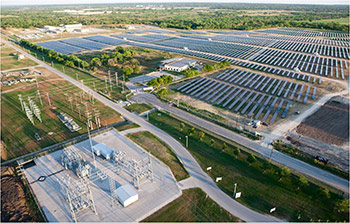
City-owned utility Austin Energy is about to sign a 25-year PPA (power purchase agreement) with Sun Edison for 150 megawatts of solar power at “just below” 5 cents per kilowatt-hour. The power will come from two West Texas solar facilities, according to reports in the Austin American-Statesman. According to reports, around 30 proposals were at prices near SunEdison’s. Austin Energy has suggested that the PV deal will slightly lower rates for customers.
This is one of the lowest, if not the lowest, reported prices for contracted solar that we have seen. Last year, First Solar (FSLR) entered a 25-year PPA in New Mexico for 50 megawatts of solar power at 5.79 cents per kilowatt-hour. That number included a significant PTC (production tax credit) from the state. The Macho Springs project, the Austin project and most solar projects of this nature rely on the 30 percent federal Investment Tax Credit.
Austin Energy’s net sub-five cent price does not include any state PTC, according to Monty Humble of energy development firm Brightman Energy. He said that the utility was “to be commended” for this solicitation. Humble added, “Based on our analysis, it can be done. There’s not a whole lot of profit in it, but it’s not a loss leader. It’s a legitimate bid.”
GTM Solar Analyst Cory Honeyman points out that “new PPAs signed in North Carolina fetched prices between 4.5 and 5 cents per kilowatt-hour.” Like Macho Springs, those projects could also take advantage of an in-state tax credit to make the economics work. Honeyman said that none of the projects in Georgia or North Carolina were larger than 20 megawatts, so 5 cents does seem like “an unprecedented low for large-scale projects.”
Bret Kadison, COO of Austin-based Brazos Resources, an energy investment firm, said this was “a highly competitive solicitation.” Although historically, “Texas hasn’t been a hotbed of solar, you’re starting to see that change. ERCOT needs the generation.”
He expects to see more solar activity “not just as a green source of energy, but as an affordable source of energy. Texas is seeing economic growth, but the power grid has not kept pace.” Kadison added, “When you think about the volatility of natural gas, a 25-year PPA starts to look pretty attractive.”
Kadison notes, “This is below the all-in cost of natural gas generation, even with low fuel prices and before factoring in commodity volatility and cost overruns.” He also points out that the original RFP was for 50 megawatts, but the utility ended up buying 150 megawatts “in a red state where hydrocarbons dominate the political landscape.” Kadison suggests that “one of the biggest cost reduction drivers that allowed solar to reach this parity came from the massive reduction in financing costs.”
The 5-cent price falls below Austin Energy’s estimates for natural gas at 7 cents, coal at 10 cents and nuclear at 13 cents. The utility points out that it approved a 16.5-cent price for the Webberville solar plant in 2009.
Austin Energy has a 35 percent renewable energy resource goal by 2016 and a solar goal of 200 megawatts by 2020. The utility is currently at about 25 percent, much of it made up by its 850 megawatts of wind.
Humble of Brightman Energy said, “I expect that this will force a lot of players to reexamine their approach and get far more aggressive. Because of the size of the ERCOT market and the size of the state, Texas is potentially the largest solar market in the country.” According to GTM Research’s 2013 U.S. SMI report, Texas ranked 8th in the nation with 75 megawatts installed in 2013.
GTM’s Honeyman notes, “This is the second major announcement in which a utility has stated plans to procure more than 100 megawatts of solar PV based on its cost-competitiveness with natural gas, as opposed to RPS-driven demand.” [Renew Economy]

November 16, 2013

Energy Revolution

The United States is undergoing the greatest revolution in energy production in decades due to the shale-gas boom and the rise of renewable energy. 

Renewable energy's share of energy production is rising rapidly. Solar, in particular, has benefited from a sharp drop in the price of photovoltaic modules as a result of a massive expansion of manufacturing capacity in recent years.


Power plants are multibillion-dollar investments and are designed to operate for decades. Thus all those natural gas-fired power plants and solar and wind farms coming online now will be fueling the economy for a good chunk of the 21st century.
The chart below shows when the capacity that we use to power the grid came online. A lot of the dirty coal plants are more than thirty years old. 
Source: US Energy Information Administration

August 11, 2013

Scituate goes 100% renewable

With the inauguration of a 3 MW solar power station, Scituate became the first town in the Commonwealth of Massachusetts to generate 100 percent of its power from alternative energy sources.

The project was developed by Gehrlicher Solar America, which earlier in 2013 opened a regional office in Boston to support its expanding New England market. Until now, the company has completed 16 MW of projects in the State and has an additional 62 MW in the pipeline.

The Scituate project was developed in partnership with Main Street Power Company, an owner and operator of solar assets, MS Solar Solutions, an indirect wholly-owned subsidiary of Morgan Stanley, project developers Syncarpha Capital and Brightfields Development, along with Scituate's local government.

"The Town is very pleased to have this important project underway, and we look forward to the financial, educational and environmental benefits it brings to the residents of Scituate," said Shawn Harris, Chairman of the Board of Selectmen for the Town of Scituate, which is also home to a 1.5 MW wind turbine project commissioned in March 2012.


August 3, 2013

Nuclear, Solar, Heat Waves and Power Prices

Pilgrim Nuclear Power Plant
The Pilgrim nuclear power plant in Plymouth, had to reduce its operating power to 85% in July due to high water temperatures in Cape Cod Bay. The Pilgrim nuclear plant requires cooling water from the bay to be below 75 degrees to operate at full power. 

The combination of the increased demand and lower power output forced peak power prices to spike at over 40 cents per kWh compared typical baseline rates of less than 4 cents per kWh. 

Isn't it ironic that our heat wave forced the power plant to reduce its output at exactly the same time that electricity demand was soaring because air conditioners were running at max power? 

Of course, solar produces its peak power during the long sunny days of summer, right at the time it is most needed. 

July 22, 2013

Sustainability News

The Georgia Public Service Commission voted in favor yesterday of a plan that will require the state's largest energy provider to increase its solar power capacity by 525 megawatts by the end of 2016. [Atlanta Business Chronicle]

Air pollution kills more than 2 million people worldwide per year, with sooty particles and ozone causing the most deaths, according to a new study. [Guardian]

Warning! The bridge is out - Natural gas prices rise - use of coal rises along with CO2 emissions [LA Times]

In Southern California, fish populations dropped 78 percent in 40 years, which experts say can't be related "to anything other than a regional oceanographic climate effect." [LA Times]
The United States is now one of four countries to achieve 10 gigawatts of solar power capacity, and installations are only expected to accelerate. [CleanTechnica]

EPA's recent retreat on a study linking fracking to drinking water contamination in Wyoming is not the only time the agency has retreated on fracking investigations and studies. [High Country News]

The Great Barrier Reef's coral cover has declined 50 percent since 1985, and its overall condition is now classified as "poor" — changes due in part to extreme weather in Australia. [Guardian]

MIT climatologist (and Lexington resident) Kerry Emanuel has a new study out showing that with unchecked greenhouse gas emissions, the world faces not just more intense hurricanes, but up to 20 more per year by the end of the century. [Climate Central]

Toronto was pummeled with a "month's worth of rain" yesterday, causing floods that stranded 1,500 on a commuter train and downed power in much of the city. [NBC News]

The life expectancy of 500 million people may have dropped 5 years due to the promotion of coal use in Northern China. [Washington Post]

Google has invested $1 billion in renewable energy, making the company a major player in the energy sector. [Fuel Fix]

Washington, D.C. is considering waiving parking space requirements for new buildings, echoing shifts other cities have made in response to shrinking car ownership. [Wall Street Journal]


June 29, 2013

Massachusetts has best solar policies

The folks over at Solar Power Rocks have gone through the solar policies of all 50 US states in order to rank them all. 

Go ahead and give yourself a big ole' pat on the proverbial back Massachusetts, you're tops in the nation for solar power! With an overall score of approximately 4.4 out of 5 possible suns (the other stars are great, but it's ours that provides all the clean renewable energy), Massachusetts narrowly edges out Maryland and New York as the friendliest state in the nation for investing in a residential solar power system. 

For a quick glance at the results, here's a colorful infographic from Solar Power Rocks

Palo Alto going 100% renewable

The city of Palo Alto (CA) has set a goal of 100% carbon-free power for its municipal utility. To achieve this goal, they are going solar in a big way…and with some mindblowing results.

The utility just signed 80 MW worth of contracts with 3 solar plants (40 MW, 20 MW, and 20 MW) at a great price: 6.9 cents/kWh over a 30 year term. Try building a new nuke or coal plant at that price.

The total output of these 3 solar plants are enough to serve about 18% of the city's load, well over the 65,000 residential customers in the city.

When these contracts come online, the city will be powered by 48% renewable energy by 2017. Quite a bit higher than the current state requirement of 33% by 2020.

And the cost impact? 1/11th of a penny per kWh. That's right. When the city approves renewable energy contracts they calculate the difference between the levelized cost of the renewable resource and the levelized cost of a comparable amount of non-renewable market power for the same period (doing their best to estimate the all-in delivered cost for both products, adjusting for time-of-delivery, transmission costs, capacity value, etc.) They use that difference to determine the net impact of the contract on the City's average retail rates. So far, they calculate the total rate impact of all of their renewables contracts to be in the range of 0.11 cents/kWh.

The plants are to be built on distressed agricultural land in Fresno, Stanislaus, and Los Angeles counties. To better ensure project viability, developers put up $30 – $35/kW in development assurance.

One more time, so it sinks in: Palo Alto is buying 80 MW of solar at 6.9cents/kWh, on track to reach 48% renewables by 2017, and all at a cost-premium over non-renewable market rates of a de minimis 0.11 cents/kWh. Truly remarkable.

These guys are early contender for utility solar champion of the decade.

http://blog.cleantechies.com/2013/06/20/palo-alto-municipal-utility-going-big-on-solar/

March 21, 2013

I ♡ Massachusetts

Here is yet one more reason I am so happy to be living in Massachusetts. 

I was privileged to hear three 3rd graders from Estabrook School speak at Town Meeting last night. They have formed a group of Estabrook students called "Save Tomorrow". They came to Town Meeting last night to ask the Town to approve installing solar panels on their school buildings. 

Photo from Lexington Patch


In contrast - the Utah State Government has decided that the theme for Earth Day this year is -  "Where Would WE Be Without Oil, Gas & Mining?" 

They are asking K-6 students to submit poster designs highlighting "how modern mining and petroleum extraction techniques and reclamation methods minimize environmental impacts while providing society with the raw materials required to have our high standard of living" as part of the Utah's Earth Day celebration. 


March 19, 2013

Interior approves 3 of the largest solar projects in history

The US Department of Interior (DOI) granted approval to three of the largest renewable energy projects in the country's history, that together will provide 1.1GW of new clean energy capacity.

Officials authorised plans for the 750MW McCoy Solar Energy Project and the 150MW Desert Harvest Solar Farm in California, as well as the 200MW Searchlight Wind Energy Project in Nevada.