June 14, 2013

The view from the watch tower

Read this story for one of the better climate change analogies ever from the Australian Business Spectator

Last night's ABC Q&A program didn't spend much time discussing the issue of climate change, but it nonetheless represented an excellent microcosm of the broader political debate on the issue.
On one side you had Bill McKibben, who has dedicated his life to the cause of reducing greenhouse gas emissions. He is trying to put the fear of God into investors that money in fossil fuels is like investing in the horse and buggy industry at the dawn of the motor vehicle. 
In the other corner was Cory Bernardi, one of the ring leaders behind the toppling of Malcolm Turnbull because of his support for an emissions trading scheme, who believes global warming is a fraud.
But on top of this, and perhaps more interesting, was the involvement of Michael Stutchbury, editor of the Australian Financial Review and former economics editor at The Australian. While not at the same extreme end of the debate as Bernardi, his comments illustrate the extremely difficult task confronting those who want Australia to take serious action to reduce emissions.
The debate was a highly familiar one to those that have been engaged in the climate debate for the last few years.  
Bernardi's argument was along the lines of:
'Well, the Earth's climate changes all the time, always has, always will and this happened well before we came along burning fossil fuels. Oh and by the way the world stopped warming since 1998 and I just saw an article the other day saying Chlorofluorocarbons were the real culprit of warming not CO2. Lastly and very importantly fossil fuels are really useful and Bill until you can fly over to Australia in a plane operating off wind power, I'm not really interested.'
McKibben's response delved down in physical and mathematical specifics:
'It has been known for a very long time that the molecular structure of CO2 traps heat which can be measured in a lab.  Even at the turn of the 19th Century Arrhenius managed to calculate that rises in CO2 would have a significant warming effect. The entire Arctic is melting before our eyes. If you stick a pH strip into the Sydney Harbour today it is 30 per cent more acidic then it would have been 40 years ago. The atmosphere holds 5 per cent more moisture leading to more extreme droughts and then floods. Peak scientific institutions like Australia's own Academy of Science back the view that we're causing global warming. We can only afford to burn 560 gigatonnes of fossil fuel carbon if we're to keep temperature rise below 2 degrees.'
Then Stutchbury was brought into the conversation. His view paraphrased:
'Yep, I have to accept that the bulk of scientific evidence suggests global warming is real. But Australia is making a lot of money from selling fossil fuels that underpins our standard of living. Also we should be proud that this is helping the poor of China and India out of extreme poverty. If we didn't sell them fossil fuels they'd get it from somewhere else anyway.'
In watching the short exchange, it brought to mind the differences in view you get when you climb from the forest floor up to the top of 30 metre tall fire watch towers that are dotted around Australia's national and state parks (example shown below). 

The height of these fire towers enables fire authority staff to see 360 degrees for tens of kilometres into the distance across vast swathes of the park. They can then spot the location of fires far into the distance so they can be attacked well before they present a dangerous threat to life or property. On the ground below these towers there is also often a view of the surrounding park, but it is obscured by the surrounding trees.
Bill McKibben was like the person sitting up high in fire watch tower able to look across the entire forest and holding some pretty big binoculars. He's describing in quite precise terms the location and size of a large bushfire several kilometres to the north and moving quickly towards us.  
Cory Bernardi on the other hand was down on the forest floor with thick forest to the north of him and looking south with squinting eyes saying, 'there's no smoke I can see or smell, you must be out of your brains Bill.'
McKibben beckons Bernardi up to the watchtower, but Bernardi says he prefers the view down on the ground and can see heaps of the forest already. Besides that there's a really nice picnic laid out on the ground with lots of delicious food he'd like to eat. 
McKibben then yells out to Stutchbury. Stutchbury admits McKibben has got some pretty good binoculars and probably has a better view, but that picnic looks really, really yummy. Besides the fire might take some time to reach them, by which time they'll be able to escape or it might change direction. 
McKibben tells him they don't have time to eat the picnic and he's got some food back at his place they can all eat. Stutchbury knows McKibben's a health freak and the food won't be as tasty as that on offer at the picnic. He decides to ask Bernardi his opinion and after balancing up their respective views, he elects to sit down and enjoy the picnic.

June 4, 2013

Car Ownership trending down

Photo Credit: Boston Globe
Has America's car ownership peaked? 

This article claims that the concept of car ownership, a paradigm of the American lifestyle in the 20th Century, is on its way out. 

Just as a generation decided it no longer needed a telephone that was hard-connected to a copper wire, an even larger group of people is starting to realize it doesn't really require a 4000-pound piece of steel in its driveway, used less than an hour a day, almost exclusively by one occupant, and propelled by a death-dealing fuel. 

Mass transit, car sharing, ride sharing, and micro-rentals – all coordinated with mobile devices, combined with small urban commuter vehicles, bicycling, and even walking, are rapidly eroding our old concept of personal transportation.


Grid Reliability and Climate Change

Talking about grid reliability without talking about climate change is like talking about personal health without talking about smoking, diet or exercise. 

Federal relief spending for climate related disasters cost taxpayers $1,200 per household over the last three years.

FEMA estimates that every dollar spent on mitigation lowers damage costs by four dollars. 

It is time to improve our grid reliability and transition to renewable energy.

Congressional Testimony by Daniel J. Weiss

Discussing electricity security and innovation while ignoring climate change is like discussing personal health while ignoring cigarette smoking, diet, and exercise. Any examination of this shifting landscape must acknowledge that our electricity-generation systems produce much of the carbon pollution responsible for climate change and that the effects of climate change impair electricity reliability. Since coal-fired power plants emit one-third of the climate pollution in the United States, it is irresponsible to assess changes in our electricity system while ignoring climate pollution and its impacts.
Americans understand that extreme weather is related to man-made climate change that costs our economy billions of dollars annually. A recent poll from Yale University and George Mason University found that many Americans believe that global warming caused recent extreme weather and climatic events to be "more severe."
Extreme weather events—including storms, floods, droughts, heat waves, and wildfires—threaten electricity reliability. The Congressional Research Service concluded that, "[P]ower delivery systems are most vulnerable to storms and extreme weather events."
These events also threaten American lives and the economy. The most severe and extreme weather events caused 1,107 deaths and $188 billion in damages in 2011 and 2012. A Center for American Progress analysis found that federal natural disaster-relief and recovery spending cost taxpayers $136 billion in the fiscal years from 2011 to 2013, or $400 per household annually. And the National Climate Assessment draft warns us that we can expect more extreme and severe weather, including droughts and rainstorms. The severe 2012 drought, for example, interfered with electricity generation in California, Connecticut, Illinois, and New York by shrinking the amount of cooling water available for power plants. It also disrupted oil and natural gas production.
Superstorm Sandy and other severe storms disrupted electricity transmission and distribution by downing power lines and damaging substations. The National Climate Assessment draft predicts that future climate-change-related events will interfere with electricity transmission.
We urge the subcommittee to support policies to achieve a more secure, reliable electricity system by accomplishing the following three goals:
1. Support policies that slow climate change by reducing carbon pollution from power plants, the largest uncontrolled source of emissions.
Failing that, EPA must at least comply with the Supreme Court by setting such standards  under the Clean Air Act.
Americans favor such pollution reductions. The poll from Yale University and George Mason University found that voters support regulating carbon dioxide as a pollutant.
And American Electric Power, Xcel, and Entergy all testified before this subcommittee earlier this year in favor of legislation to address climate change.
Finally, there is no evidence that pollution standards for power plants impair reliability. The Federal Energy Regulatory Commission, the Department of Energy, and the Congressional Research Service all found that the Mercury Air Toxics Standard has no impact on reliability. A Department of Energy and Congressional Research Service analysis found that the biggest impediment to reliability is weather.
2. Provide financial incentives for innovative energy efficiency and no- or low-carbon electricity technologies, which would reduce reliance on dirty fossil fuels responsible for climate change.
Federal investments in emerging clean energy technologies should continue. Historically, fossil fuels have received vastly more federal support than renewable technologies.
The Nuclear Energy Institute, for example, found that over the past 60 years, 70 percent of federal energy spending went to fossil fuels, while only 10 percent was for renewables.
3. Act to enhance the resilience of the electricity infrastructure to extreme storms, drought, sea level rise, and other impacts of climate change. 
Investments in resiliency to extreme weather save money. The Federal Emergency Management Agency estimates that "a dollar spent on [pre-disaster] mitigation saves society an average of $4" in lower damages.
Yet even as extreme weather increases, the federal government is investing less in community resilience.
Rep. Lois Capps and 39 of her colleagues urged the federal government to undertake a plan that:
  • Identifies federal programs that already provide funding for resilience efforts
  • Estimates the financial support necessary to helps communities prepare for the anticipated impacts of increased climate-related extreme weather
  • Creates a dependable revenue stream to provide additional resources for local pre-disaster mitigation planning
In addition, the Congressional Research Service recommends more investments in smart-grid and transmission repairs to improve reliability.
The growing harm from climate change necessitates prompt transition from dirty to cleaner electricity generation. This is underway here and overseas. Iowa, for example, generates 20 percent of its electricity from wind. And six years after a devastating tornado, Greensburg, Kansas, is "100 percent renewable energy, 100 percent of the time."
Looking abroad, Portugal produced 70 percent of energy with renewables in the first quarter of 2013. And Germany generated 26 percent of its electricity from renewable sources in the first half of 2012.
Congress must adopt policies that speed this transition across the nation, while helping our electricity system become more resilient to damages from climate-related storms, floods, droughts, and other extreme weather.
Daniel J. Weiss is a Senior Fellow and the Director of Climate Strategy at the Center for American Progress Action Fund.
Thanks to Mari Hernandez, Research Associate, and Jackie Weidman, Special Assistant, on the Energy Policy team of the Center for American Progress Action Fund.

Like it Hot? Fish don't

World's fish are moving to cooler waters  

Blue Crab Credit: Paleo Spirit

Fish and other sea life have been moving toward Earth's poles in search of cooler waters, part of a worldwide, decades-long migration documented for the first time by a study released Wednesday. The research, published in the journal Nature, provides more evidence of a rapidly warming planet and has broad repercussions for fish harvests around the globe.

The Pacific Northwest is seeing giant squid come up from Mexico. The British are finding more red mullet and less cod. Scandinavians are seeing swordfish come up from the Mediterranean. West Coast salmon are being forced to find more northerly rivers to spawn.
As for New England, surf clams are becoming more established here, while a processing plant in their former home base of Virginia has closed. But it also means that some iconic cold-water species, such as cod, may swim farther north or away from warmer coastal waters. Princeton fisheries researcher Malin Pinsky, who last year charted northward shifts in the populations of flounder, red hake, and lobster, offered this suggestion, only slightly tongue in cheek: New Englanders should think about adding a little Chesapeake Bay crab to their chowder.
University of British Columbia researchers found that significant numbers of 968 species of fish and invertebrates they examined moved to escape the warming waters of their original habitats. Previous studies had documented the same phenomenon in specific parts of the world's oceans. But the new study is the first to assess the migration worldwide and to look back as far as 1970, according to its authors.
The research is more confirmation that "global change is real and has been real for a long time," said Boris Worm, a professor of marine biology at Dalhousie University in Halifax, Nova Scotia, who was not part of the study. "It's not something in the distant future. It is well underway."

[Washington Post] [Boston Globe]

Pakistan's response to heat wave - No socks

Pakistan's civil servants have been told that
moccasins or sandals must be worn without socks.
Photograph: David Levene for the Guardian
Pakistan has told its civil servants not to wear socks as the country turns off air-conditioners amid soaring temperatures to deal with chronic power cuts. [Guardian]

The government has turned off all air-conditioning in its offices as the country endures blackouts of up to 20 hours a day in in temperatures of 104 degrees F. 

"There shall be no more use of air-conditioners in public offices till such time that substantial improvement in the energy situation takes place," a cabinet directive said. As part of a new dress code, moccasins or sandals must be worn without socks.

The power shortages have sparked violent protests and crippled key industries, costing hundreds of thousands of jobs in a country already beset by high unemployment, a failing economy, widespread poverty and a Taliban insurgency.

The "load-shedding" means many families cannot pump water, let alone run air-conditioners, with disastrous knock-on effects on health and domestic life.

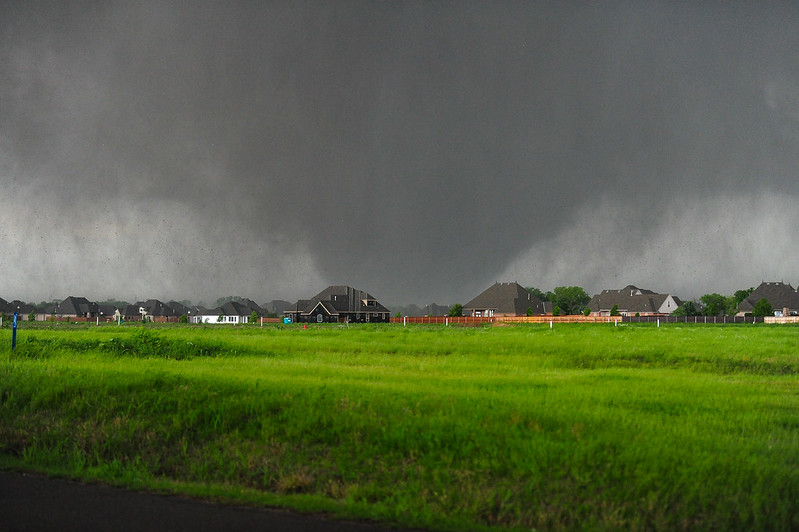
What do we know about tornados and climate change?

EF5 Tornado as it reaches Moore, OK - Credit: wahoorob 80 at Flickr
The big tornado outbreak, including a monster Oklahoma twister, have people asking again about a possible link to climate change. Tom Karl, the director of the National Climatic Data Center, explains:


What we can say with confidence is that heavy and extreme precipitation events often associated with thunderstorms and convection are increasing and have been linked to human-induced changes in atmospheric composition.

Tornadoes "come from certain thunderstorms, usually super-cell thunderstorms," explained climatologist Dr. Kevin Trenberth, but you need "a wind shear environment that promotes rotation." Global warming may decrease the wind shear and that may counterbalance the impact on tornado generation from the increase in thunderstorm intensity.

Trenberth, the former head of the Climate Analysis Section of the National Center for Atmospheric Research, notes:
The main climate change connection is via the basic instability of the low level air that creates the convection and thunderstorms in the first place. Warmer and moister conditions are the key for unstable air.
The climate change effect is probably only a 5 to 10% effect in terms of the instability and subsequent rainfall, but it translates into up to a 32% effect in terms of damage. (It is highly nonlinear). So there is a chain of events and climate change mainly affects the first link: the basic buoyancy of the air is increased.  
Here is Trenberth again with some added context:
It is irresponsible not to mention climate change in stories that presume to say something about why all these storms and tornadoes are happening.
The environment in which all of these storms and the tornadoes are occurring has changed from human influences (global warming). Tornadoes come from thunderstorms in a wind shear environment. This occurs east of the Rockies more than anywhere else in the world. The wind shear is from southerly (SE, S or SW) flow from the Gulf overlaid by westerlies aloft that have come over the Rockies. That wind shear can be converted to rotation. The basic driver of thunderstorms is the instability in the atmosphere: warm moist air at low levels with drier air aloft. With global warming the low level air is warm and moister and there is more energy available to fuel all of these storms and increase the buoyancy of the air so that thunderstorms are strong. There is no clear research on changes in shear related to global warming. On average the low level air is 1 deg F and 4 percent moister than in the 1970s.
Moore Tornado Aftermath - Creditwahoorob 80 at Flickr

NY Times calls for aggressive action on climate

New York Times again calls on President Obama to take more aggressive action on climate change.

The news that atmospheric concentrations of carbon dioxide, the most important global warming gas, have hit 400 parts per million for the first time in millions of years increases the pressure on President Obama to deliver on his pledges to limit this country's greenhouse gas emissions.

America cannot solve a global problem by itself. But as Mr. Obama rightly observed in his inaugural address, the United States, as both major polluter and world leader, has a deep obligation to help shield the international community from rising sea levels, floods, droughts and other devastating consequences of a warming planet. In his State of the Union speech, he promised to take executive action if Congress failed to pass climate legislation.

Which is just what he will have to do. The prospects for broad-based Congressional action putting a price on carbon emissions are nil. The House is run by people who care little for environmental issues generally, and Senate Republicans who once favored a pricing strategy, like John McCain and Lindsey Graham, have long since slunk away. Meanwhile, Republicans on the Senate Environment and Public Works Committee have spent the last two weeks trying to derail Mr. Obama's nominee to run the Environmental Protection Agency — a moderate named Gina McCarthy. Ms. McCarthy has served two Republican governors (Mitt Romney was one) but is considered suspect by the right wing because she wants to control carbon pollution, which is driving global temperatures upward.

Hence the need for executive action. Yet we are now four months into Mr. Obama's second term, and there is no visible sign of a coherent strategy. One plausible reason is that Mr. Obama has been preoccupied with other issues and that his key players on climate have not been in place. But that excuse disappears if Ms. McCarthy can survive a threatened Senate filibuster; even if she does not, Mr. Obama has sufficient talent in the E.P.A. and the Energy Department and among his science advisers to get started.

As this page has noted, it is possible to adopt a robust climate strategy based largely on executive actions. The most important of these is to invoke the E.P.A.'s authority under the Clean Air Act to limit pollution from stationary industrial sources, chiefly the power plants that account for almost 40 percent of the country's carbon emissions. The agency is reworking a proposed rule to limit emissions from new power plants. A more complex but no less necessary task is to devise rules for existing power plants, which cannot be quickly shuttered without endangering the country's power supply, but which can be made more efficient or phased out over time.

Mr. Obama can also order the E.P.A. to curb the enormous leakage of methane, a potent global warming agent, from gas wells and the pipes that bring natural gas to consumers. This is critical if America's bountiful supplies of cheap natural gas are to become a cleaner bridge from coal to alternative energy sources like wind and solar power.
He can hasten the development of less-polluting alternatives to older-generation refrigerants and other chemicals. He can order the Energy Department to embark on a major program to improve the efficiency of appliances and commercial and residential buildings, which consume a huge chunk of the country's energy supply. And he can ramp up investment in basic research.

All of this will take time, which is why it is important to get started. The most important of Mr. Obama's first-term environmental initiatives — the historic fuel economy standards that will double the efficiency of America's cars and light trucks — took more than three years to complete between the time they were proposed and when they were finalized last August. New power plant standards can be expected to take at least as long.

Mr. Obama has a firm grasp of the climate issue, and no one doubts that he cares about it. But as is often the case with this president, the question is whether he will exhibit a sense of urgency to match his intellectual understanding.