Showing posts with label National Parks. Show all posts

February 4, 2013

Hiking the Grand Canyon - from Google Street View


Google will now allow you to hike the Grand Canyon via Google Street View!   

I've been to the Grand Canyon three times in my life. This morning I was able to take a look at 5 parts of the park I've never seen - before breakfast. 


Many more amazing photos - click the link below to see them. 

October 22, 2012

Grand Canyon in the Crosshairs


Arizona has become ground zero for the ideological fight against public lands and national parks during the 2012 election.  This is due to a combination of factors, including a Senate race featuring a former uranium industry lobbyist who has led the fight to mine around the Grand Canyon, a state ballot measure that would turn all federal public lands over to the state, and Republican presidential candidate Mitt Romney’s energy plan that would make it easier to mine and drill on public lands.
First, the Grand Canyon has played an important role in the Arizona Senate race between Richard Carmona (D) and Jeff Flake (R).  Flake has led the fight in Congress to roll back a ban on new uranium mining around the canyon, and at one point his efforts were referred to as “the Flake earmark for the mining industry.”
Just this past Saturday, Flake — who was once a lobbyist for an African uranium mine with ties to Iran — continued to attack the Grand Canyon, and referred to the lands around it as “prime mining lands” when he gave the weekly Republican address.
Additionally, Proposition 120 will be on Arizona’s ballot on November 6th.  This measure would add language to the state constitution, giving Arizona “sovereign and exclusive authority and jurisdiction” over natural resources within its boundaries including air, water, wildlife, and public lands (including the Grand Canyon).  It would also, according to legislative analysis, “repeal Arizona’s disclaimer of all right and title to public lands within the state,” an action which one legal expert says is “almost certainly unconstitutional.”
Lastly, Republican presidential candidate Mitt Romney’s energy plan could prove disastrous for the Grand Canyon and other public lands across America.  One of the key components of his plan is turning decisions about energy development on public lands over to the states.  This is problematic because, as the New York Times put it, “state, as a rule, tend to be interestedmainly in resource development.”
The Romney energy plan would mean that the state of Arizona would decide whether or not to permit uranium mining around the Grand Canyon.


October 8, 2012

Noble Basin saved from oil and gas drilling

A national land conservation group has stepped in to save a rugged, isolated corner of northwestern Wyoming from oil and  gas development that had threatened the area prized for its wildlife habitat, mountain scenery and hunting and recreational opportunities.

The threat to the Noble Basin was portrayed in a video report by the Center for American Progress earlier this year. Watch the video to see how incredibly beautiful this section of the world is. 

Under the agreement, The Trust for Public Land will pay $8.75 million to purchase oil and gas leases on 58,000 acres in the Wyoming Range from Houston-based Plains Exploration and Production (PXP), and permanently remove the threat of drilling by retiring the leases. The trust has raised about half of the purchase price but must secure the remaining funds by the end of the year.

The area, known as the Noble Basin or Upper Hoback Basin, is part of the Bridger-Teton National Forest and is located about 30 miles south of Jackson, WY.


August 31, 2012

Romney promises to end federal oversight of oil and gas drilling

Mitt Romney is proposing to end a century of federal control over oil and gas drilling and coal mining on all government lands including national parks. 


Here are five places that could be at risk under a Romney energy plan:
-  Grand Canyon National Park:  Even though Interior Secretary Ken Salazar protected one million acres around the Grand Canyon from mining last January, the decision applied only to new claims.  About 3,500 existing uranium claims may still be valid, which could result in up to 11 uranium mines on Bureau of Land Management and Forest Service lands near the canyon.  Under a Romney energy plan, the decision to permit these new mines would be made by the state of Arizona and under its rules and regulations.  Arizona Governor Jan Brewer would likely give the go-ahead to new mining, as she called Salazar’s decision in January “excessive and unnecessary regulation.” 

-  Bryce Canyon National Park:  A strip coal mine is currently being proposed on Bureau of Land Management lands ten miles from the park, but the National Park Service warned that it would “likely result in negative impacts to park resources and visitors” and especially to air quality and scenery.  Under the Romney energy plan, the state of Utah would be responsible for permitting and overseeing the new mine.  Chances are it would be permitted, as Utah already gave the go-ahead to a coal mine right next to the proposed one. 

-  Arches National Park:  The final hours of the George W. Bush presidency saw the issuance of 77 oil and gas leases very close to national parks, including Arches. In January 2009, new Interior Secretary Ken Salazar canceled the leases, saying that they had been rushed.  But that decision is not permanent — if and the oil and gas industry proposed drilling there again, these and other leases on the edges of Arches could move forward.  And the state of Utah would probably accept those industry demands, since its governor and legislature this year called for title to all 30 million acres of public lands to “help foster economic development.”

-  Theodore Roosevelt National Park:  North Dakota is ground zero for the Bakken oil boom, which is pressing up against this national park where President Theodore Roosevelt developed much of his conservation ethic.  Already drilling rigs can be seen from within the park.  And even more could be built if aproposed bridge is permitted that could open up even more of the adjacent Little Missouri Grasslands (managed by the Forest Service) to oil and gas drilling.

-  Grand Teton National Park: This park borders the Bridger-Teton National Forest, home to significant natural gas resources.  Currently the Forest Service is determining whether to allow the drilling of up to 136 natural gas wells on its lands, which could have a number of impacts on the park.  Grand Teton National Park’s superintendent expressed concerns about “degradation of visibility” from the project, and other officials have worried about impacts on the park’s wildlife.  If this decision were turned over to the state under the Romney energy plan, the project could potentially go forward. Wyoming Governor Matt Mead has stated that the company has “valid existing rights.” 

http://nyti.ms/Syv1r5
http://bit.ly/RwEuiC

July 14, 2012

Public Lands, Private Profits

Should we mine for uranium on Grand Canyon? Should we frack the Bridger Teton National for natural gas? Should we mine for coal near Bryce Canyon?


This short video series talks about current plans to do all three. If you care about the future of some of America's greatest treasures and the most beautiful areas of our country - watch these videos.


June 20, 2012

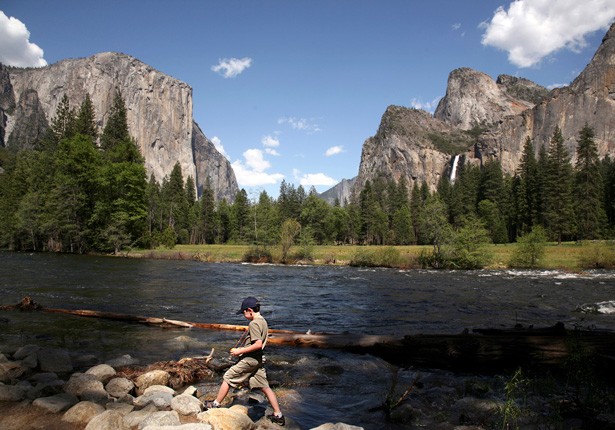
Take a young person to a park

This past week, NBC News reported on a rather upsetting trend among national parks visitors. It seems that instead of the young backpacker often associated with national parks, the average national park visitor is actually middle-aged.

In Rocky Mountain National Park, for instance, the average age of a visitor is 46. In Yosemite National Park, only 11% of visitors are in their 20s. And in Yellowstone that number is down at 6%. By comparison, a 1996 study conducted in Death Valley National Park revealed that almost a third of visitors were in their 20s.

So why are these statistics such a problem? Well, it could mean less support for national parks in the future. Once older generations of park goers become unable to travel, who's going to visit the parks? How will the parks continue to maintain a steady source of revenue?

Even more worrisome is the fact that if future generations don't appreciate national parks, the parks may lose some of their political protection and government funding. After all, politicians respond to the will of the populace. And if the populace doesn't care about national parks…