Showing posts with label Divestment. Show all posts

November 5, 2013

DeChristopher to Faust - You can't be neutral

Harvard President Faust and Harvard Divinity Student Tim DeChristopher

Tim DeChristopher wrote an incredibly powerful and important letter to the President of Harvard on her decision not to divest from fossil fuels.  

Renowned climate activist Tim DeChristopher, newly arrived at Harvard Divinity School after serving a two-year federal sentence for peaceful civil disobedience, is now a member of the "Harvard community" addressed by Faust.

Drew Faust seeks a position of neutrality in a struggle where the powerful only ask that people like her remain neutral. She says that Harvard's endowment shouldn't take a political position, and yet it invests in an industry that spends countless millions on corrupting our political system. In a world of corporate personhood, if she doesn't want that money to be political, she should put it under her mattress. She has clearly forgotten the words of Paolo Freire: "Washing one's hands of the conflict between the powerful and powerless means to side with the powerful, not to remain neutral." Or as Howard Zinn put succinctly, "You can't be neutral on a moving train."

She touts all the great research on climate change that is done at Harvard, but she ignores the fact that the fossil fuel industry actively works to suppress or distort every one of those efforts. To seriously suggest that any research will solve the climate crisis while we continue to allow the fossil fuel industry to maintain a stranglehold on our democracy is profoundly naive. Faust never admits whether or not she agrees with the basic science of the carbon budget, which is the foundation of the understanding that the current reserves of the fossil fuel industry cannot be burned without condemning us to an unlivable future. If she accepts the science, she should explain how her plan of cooperation will convince the industry to leave those assets in the ground.

Faust's claim that the university should not divest while it continues to consume fossil fuels obfuscates the fact that divestment is about undermining the political power of the fossil fuel industry. Energy is a market driven not by consumers but by political influence, yet Faust alludes to the worn out old argument that the consumers of fossil fuels don't have a right to object to the crimes against humanity committed by an industry that uses political leverage to prevent alternatives. As a historian of the Civil War, surely Faust knows that the exact same argument was made to defend slavery, an energy source that was once every bit as vital to our economy as fossil fuels are today.

The students' call for divestment was a call for help by the young people who will reap the consequences of the climate crisis. The industry committed to ruining our future simply asked Faust to stay out of it. There is no way for someone in a position of influence to not take a side in such a situation. That's why leadership is no place for a coward. By turning her back on those calling for help, Faust absolutely took a side. I strongly suspect that time will show that she chose the wrong side of history. When our generation writes Drew Faust into the history books, being not as bad as Larry Summers will not suffice as a position of honor. Harvard needs leaders better able to see beyond their own time, and the students who will continue to push for divestment are a great example.

—Tim DeChristopher

April 3, 2013

Victory at Hand for Climate Movement?

Paul Gilding has a very positive view of our future, "Victory at Hand for the Climate Movement?" Here's an excerpt:
There are signs the climate movement could be on the verge of a remarkable and surprising victory.  If we read the current context correctly, and if the movement can adjust its strategy to capture the opportunity presented, it could usher in the fastest and most dramatic economic transformation in history. This would include the removal of the oil, coal and gas industries from the economy in just a few decades and their replacement with new industries and, for the most part, entirely new companies. It would be the greatest transfer of wealth and power between industries and countries the world has ever seen…. 
To summarise:
- The science shows how we are not just failing to slow down climate change, but are in fact accelerating towards the cliff.
- In response, mainstream organisations focused on the global economy are becoming increasingly desperate in their calls for action, fearing the economic consequences if we don't.  They are arguing that the only way the world can avoid the risk of breakdown is to transform the economy urgently and dramatically.
- Our capacity to do so is now real and practical, with the technologies required already being deployed at very large scale and at competitive cost. The size of the business opportunity now on offer is truly breathtaking.
- In response, the financial markets are waking up to the transformation logic – if the future is based in renewables and these are price competitive without subsidy, or soon will be, the transformation could sweep the economy relatively suddenly, even without further government leadership.
- This then puts in place an enormous and systemic financial risk – in particular investments in, or debt exposure to, the multi-trillion $ fossil fuel industry.
- This risk is steadily being increased by activist campaigns against fossil fuel projects (worsening each projects' financial risk) and arguing for fossil fuel divestment (putting investors reputation in play as well).
- In response investors and lenders will reduce their exposure to fossil fuels and hedge their risk by shifting their money to high growth renewables.
- This will then reinforce and manifest the very trend they are hedging against.
- Thus it's game on. 
Is that it? Can we now sit back and expect the market deal with this?
Most definitely not….
You can read the whole article here.

March 3, 2013

The Case for Fossil Fuel Divestment

Bill McKibben has written yet another must read article in Rolling Stone - on the inevitability of the divestment movement on college campuses. 

"The logic of divestment couldn't be simpler: if it's wrong to wreck the climate, it's wrong to profit from that wreckage." 

January 22, 2013

Divestment Movement spreads to religious communities

A fast-spreading movement to persuade universities to rid their endowments of fossil fuel assets is now taking root in America's churches and faith communities. "With the civil rights movement, the youth led and the churches followed," said Fred Small, minister of the Unitarian Universalist First Parish Church in Cambridge, Mass. The church is one of dozens of congregations across the country exploring how to divest their portfolios of coal, oil and gas companies. "If young people see divestment as a key issue in the climate fight, then it is important for us to get involved," Small said.

The furthest along is the 1.2 million-member United Church of Christ, which will hold a national vote in June to adopt a fossil fuel divestment measure. Since November, divestment campaigns have spread to 210 universities in the United States and Canada, and to the city of Seattle, the first municipality seeking to divest its $1.9 billion pension fund.

The campaign is organized by 350.org, a grassroots climate organization founded by author turned activist Bill McKibben. It is part of a larger effort to boost the moral case for action by drawing attention to what McKibben calls global warming's "terrifying new math." Based on peer-reviewed science, the numbers say energy firms must keep 80 percent of their carbon reserves in the ground to limit the global temperature rise to the crucial 2-degrees Celsius mark.
In an interview, McKibben said involvement of faith communities is crucial for climate action to become a great American movement. [Inside Climate News]


December 8, 2012

Harvard agrees to discuss divestment with students


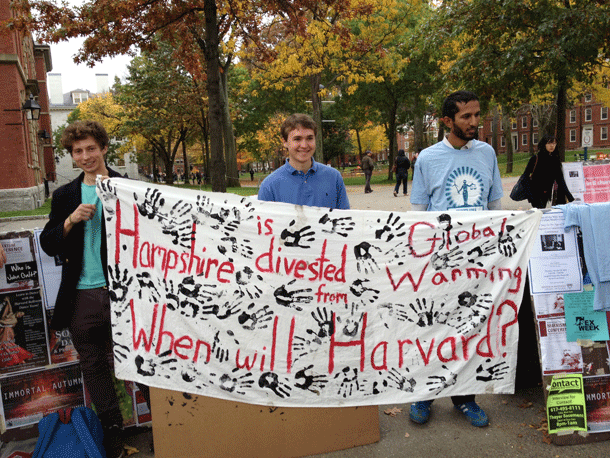
The Harvard Crimson reports that Harvard University leaders will sit down with student advocates of fossil fuel divestment and explore the possibility of creating a social choice fund, senior University officials told The Crimson this week.
Members of the Corporation's Committee on Shareholder Responsibility will meet with students next semester who over the course of the fall have advocated for the University to divest its more than $30 billion endowment from fossil fuels.
When the issue was offered as a referendum during Undergraduate Council elections last month, 72 percent of undergraduates who voted supported divestment.

Corporation members said the University is entertaining the creation of a social choice fund—a fund to which alumni could donate that would be invested with an eye towards Socially Responsible Investment. SRI encourages the incorporation of environmental, social, and governance concerns into the evaluation of investments.