August 11, 2013

Fracking company bans children from talking - forever

When drilling company Range Resources offered the Hallowich family a $750,000 settlement to relocate from their fracking-polluted home in Washington County, Pennsylvania, it came with a common restriction. Chris and Stephanie Hallowich would be forbidden from ever speaking about fracking or the Marcellus Shale. But one element of the gag order was all new. The Hallowichs' two young children, ages 7 and 10, would be subject to the same restrictions, banned from speaking about their family's experience for the rest of their lives.
The Hallowich family's gag order is only the most extreme example of a tactic that critics say effectively silences anyone hurt by fracking. It's a choice between receiving compensation for damage done to one's health and property, or publicizing the abuses that caused the harm. Virtually no one can forgo compensation, so their stories go untold. [Climate Progress] [Yahoo]

The Hallowich family (photo: Pat Panchak/Pittsburgh Post-Gazette)

EDF switching from nuclear to renewables

Calvert Cliffs Nuclear Power Plant
The French utility EDF, the world's biggest operator of nuclear plants, is pulling out of nuclear energy in the United States, bowing to the realities of a market that has been transformed by cheap shale gas. "Circumstances for the development of nuclear in the U.S. are not favorable at the moment," Proglio said.
 

FOCUS ON RENEWABLES IN U.S.

Proglio said EDF would now focus on renewable energy in the United States. EDF employs 860 people in U.S. solar and wind, and since 2010 its generating capacity has doubled to 2.3 gigawatts. It manages another 7 gigawatts for other companies. 

Several nuclear reactors in the U.S. have been closed or are being shuttered as utilities balk at the big investments needed to extend their lifetimes now that nuclear power has been so decisively undercut by electricity generated from shale gas.

"The spectacular fall of the price of gas in the U.S., which was unimaginable a few years ago, has made this form of energy ultra-competitive vis a vis all other forms of energy," EDF Chief Executive Henri Proglio told a news conference.

EDF agreed with its partner Exelon Corp. on an exit from their Constellation Energy Nuclear Group (CENG) joint venture, which operates five nuclear plants in the United States with a total capacity of 3.9 gigawatts.

EDF, Europe's biggest power producer by output, also employs 320 staff in its U.S. energy trading operation, which is the No. 1 exporter of U.S. coal to Europe. [Reuters]


A Nation on Fire

Firenado in the Douglas Complex wildfire Photo taken by Marvin Vetter of the Oregon Department of Forestry
Dan Oltrogge started fighting wildfires in 1984. Starting around 2000, Oltrogge began experiencing fires of a scale and intensity he never expected to encounter. Fires like the Rodeo-Chediski in Arizona in 2002 — at 467,000 acres, the largest in the state's history — and 9 years later the Wallow, which surpassed the Rodeo-Chediski and set a new state record of 538,000 acres.
"We never imagined we would be on a fire of a half million acres in the lower 48," said Oltrogge. "Now they're becoming commonplace."
Huge, explosive fires are becoming commonplace, say many experts, because climate change is setting the stage — bringing higher temperatures, widespread drought, earlier snowmelt and spring vegetation growth, and expanded insect and disease infestations.[Climate Progress] [Mother Jones]

Carbon Tax is working in British Columbia

A lake and waterfall in the Niut Range,
British Columbia, Canada. Photograph: alamy.com
Five years in, BC's carbon tax has successfully reduced greenhouse gas emissions in a stable economy.

Carbon emissions have an unavoidable cost. When we burn fossil fuels and release carbon dioxide into the atmosphere, it increases the greenhouse effect. The resulting climate change has costs, for example by causing more extreme weather. More frequent and intense heat waves and droughts can damage crops, causing food prices to rise, more intense floods can cause more property damage, etc.

Lacking a price attached to carbon emissions in the marketplace, we're effectively putting those costs on a credit card. We may not immediately see the costs, but they keep building up. In fact they're building up with interest, because the costs of climate damage are higher than the costs of reducing greenhouse gas emissions. When we put a price on carbon in the marketplace, consumers can see the costs associated with greenhouse gas emissions and adjust their consumption in an informed manner without continuing to build up that climate credit card debt.

There are several options for pricing carbon emissions, but the alternative with the most support among political conservatives is a revenue-neutral carbon tax. In this system, a fee is attached to fossil fuel products based on their associated carbon emissions, and 100 percent of the revenue is returned to the citizens. People thus have an incentive to reduce emissions such that the revenue they receive is larger than the taxes they pay, allowing them to make money on the system by reducing their impact on the climate.

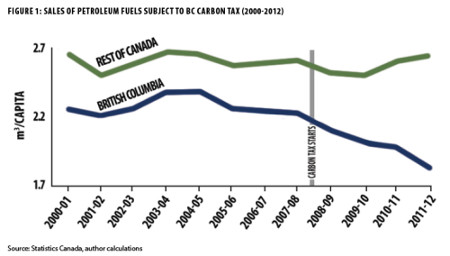
In 2008, British Columbia implemented a carbon tax, with the revenue returned to citizens through lowered income taxes. A new peer-reviewed study examines the data through 2012 to see how British Columbia's emissions and economy have fared, and the results are impressive. Consumption of taxed fuels per capita has fallen 19 percent in British Columbia relative to the rest of Canada.
Per capita fossil fuel consumption
As a result, British Columbia's greenhouse gas emissions fell 10 percent between 2008 and 2011, as compared to a 1.1 percent decline for the rest of Canada.

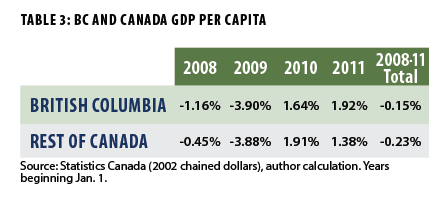
The carbon tax was introduced right before the recession hit in 2008, so while Gross Domestic Product (GDP) fell slightly between 2008 and 2011 in British Columbia, that change was on par with the small decline in Canada's GDP. Thus while it's inconclusive whether the carbon tax is helping or hurting British Columbia's economy, it's certainly not having the seriously damaging economic effect that alarmist opponents claim that carbon taxes will have.
GDP per capita
Polls also show that public support for the British Columbia carbon tax has grown to 64 percent, and 59 percent of Canadians say they would support a similar carbon tax system in their provinces. The popularity may be in part a result of the fact that by offsetting the carbon taxes, British Columbia has the lowest income taxes in Canada.

Over its first five years, British Columbia's carbon tax has served as a great example of a way to reduce greenhouse gas emissions by cutting up the climate credit card. They implemented a carbon tax, the economy didn't collapse (or even take notice), and the citizens are happy with the system. The question now is whether other governments like in the USA will follow suit. [Guardian]


Oil Spill in Thailand

Crude oil has blanketed water and beaches at a Thai vacation spot after an offshore pipeline leaked an estimated 13,200 gallons of oil into the Gulf of Thailand.

The spill occurred about 12 miles off the coast of Rayong, Thailand, and reached Ao Prao beach on the island of Koh Samet. About 1,900 feet of white sandy beach was covered in oil. [Climate Progress]
Thai Oil Spill
CREDIT: Credit: AP

oil spill Thai
CREDIT: Shuttershock


Scituate goes 100% renewable

With the inauguration of a 3 MW solar power station, Scituate became the first town in the Commonwealth of Massachusetts to generate 100 percent of its power from alternative energy sources.

The project was developed by Gehrlicher Solar America, which earlier in 2013 opened a regional office in Boston to support its expanding New England market. Until now, the company has completed 16 MW of projects in the State and has an additional 62 MW in the pipeline.

The Scituate project was developed in partnership with Main Street Power Company, an owner and operator of solar assets, MS Solar Solutions, an indirect wholly-owned subsidiary of Morgan Stanley, project developers Syncarpha Capital and Brightfields Development, along with Scituate's local government.

"The Town is very pleased to have this important project underway, and we look forward to the financial, educational and environmental benefits it brings to the residents of Scituate," said Shawn Harris, Chairman of the Board of Selectmen for the Town of Scituate, which is also home to a 1.5 MW wind turbine project commissioned in March 2012.


Natural Gas - Bridge or Gangplank?

Satellite view of gas wells dotting Utah’s Uinta Basin (via CIRES)
A NY Times op-ed written by Cornell civil engineering professor highlights the problem of methane leaks from natural gas wells. 

Industry studies show that 5% of all new well casings fail and leak methane immediately upon completion and those rates increase dramatically as the wells get older with 50% of all well casings failed and leaking after 35 years again according to industry studies. 

A new report has found 6.2% to 11.7% methane leakage from a Utah natural gas drilling site. Natural gas drilling and extraction with those leakage rates means that natural gas is far worse than coal for GHG emissions.

A Boston Globe article highlights the work done by Boston University professor Nathan Phillips, that the leaks that are occurring in our local pipelines here in the Boston area can also have a significant effect on climate change.

Natural gas is worse for the climate than coal if we don't fix these leaks. [Boston Globe]

Upper panel: Yellow light shafts showing 3,300-plus natural gas leaks
with methane concentration (ppm) along Boston’s 785 miles of road, in red.
Lower panel: Leaks around Beacon Hill and the Massachusetts statehouse
with methane concentration (ppm). Images courtesy of Nathan Phillips