
March 3, 2013
GM accelerates Chevy Volt Production


Ford accelerates waste reduction effort

Ford said the effort will also have financial benefits for the firm.
Becoming a demitarian
 First, we were urged to become locavores - people who eat food from their local area.
Now there is a new word to consider - "demitarian" - for people who eat half as much meat as usual.
Eating less meat may be easier than you thought. In fact, most Americans ate significantly less meat 10 years ago, even less meat 20 years ago, and less again for each decade you go back in time. We eat 5 times more meat today than we did just 100 years ago.
Americans eat 50 pounds more chicken per capita per year today when compared to the 50's. We eat 10 pounds more turkey, 5 pounds more fish and 12 pounds more beef per capita per year than we did in the 50's. [USDA Factbook] [USDA ERS]
"Eat meat, but less often – make it special," he urged. "Portion size is key. Many portions are too big, more than you want to eat. Think about saying, 'I like the taste, but I don't need so much.'"
By filling plates with vegetables as well as the meat, people will be better nourished. "Most people don't notice," he said, citing a recent event at which the chef used less meat and more vegetables.
Climate Action in China
Wind has overtaken nuclear as an electricity source in China. In 2012, wind farms generated 2 percent more electricity than nuclear power plants did, a gap that will likely widen dramatically over the next few years. Wind developers connected 19,000 megawatts of wind power capacity to the grid during 2011 and 2012, and they are expected to add nearly this much in 2013 alone. China should easily meet its official target of 100,000 megawatts of grid-connected wind capacity by 2015.


China is among the world's largest emitters of greenhouse gas and has set goals for cutting emissions. The government has vowed to reduce carbon intensity, or the amount of carbon dioxide emitted per unit of economic output, by 40 to 45 percent by 2020 in comparison to 2005 levels. China will proactively introduce a set of new taxation policies designed to preserve the environment, including a tax on carbon dioxide emissions.
The government will collect the environmental protection tax instead of pollutant discharge fees, as well as levy a tax on carbon dioxide emissions, Jia Chen, head of the Ministry of Finance's tax policy division, wrote in an article published on the MOF's website.
[Xinhua - Chinese State News Agency]
[Xinhua - Chinese State News Agency]
Twice as many extreme snowstorms - but...
Twice as many extreme snowstorms... but, total snowfall is shrinking!
The United States has been walloped by twice as many of the most extreme snowstorms in the past 50 years than in the previous 60 years, according to an upcoming study on extreme weather by leading federal and university climate scientists. This also fits with a dramatic upward trend in extreme winter precipitation — both rain and snow — in the Northeastern U.S. charted by the National Climatic Data Center.
Yet the Global Snow Lab at Rutgers University says spring snow cover in the Northern Hemisphere has shrunk on average by 1 million square miles in the past 45 years.
And an upcoming study in the Journal of Climate says computer models predict annual global snowfall to shrink by more than a foot in the next 50 years. The study's author said most people live in parts of the United States that are likely to see annual snowfall drop between 30 percent and 70 percent by the end of the century….
Ten climate scientists say the idea of less snow and more blizzards makes sense: A warmer world is likely to decrease the overall amount of snow falling each year and shrink the snow season. But when it is cold enough for a snowstorm to hit, the slightly warmer air is often carrying more moisture, producing potentially historic blizzards.
"Strong snowstorms thrive on the ragged edge of temperature — warm enough for the air to hold lots of moisture, meaning lots of precipitation, but just cold enough for it to fall as snow," said Mark Serreze, director of the National Snow and Ice Data Center. "Increasingly, it seems that we're on that ragged edge."
[Washington Post]
The Keystone Principle - Stop Making it Worse
Here is an excellent article stating the principle behind climate action and the Keystone pipeline protests - Stop Making it Worse.

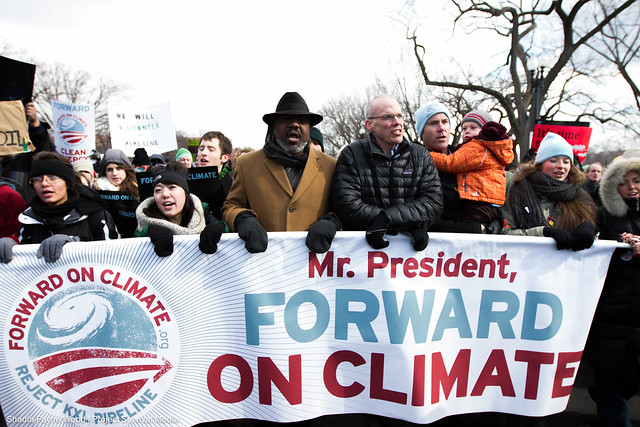
After a year of unprecedented destruction due to weather extremes, the climate fight is no longer just about impacts in the future. It's about physical and moral consequences, now. And Keystone isn't simply a pipeline in the sand for the swelling national climate movement. It's a moral referendum on our willingness to do the simplest thing we must do to avert catastrophic climate disruption: Stop making it worse.
Specifically and categorically, we must cease making large, long-term capital investments in new fossil fuel infrastructure that "locks in" dangerous emission levels for many decades. Keystone is a both a conspicuous example of that kind of investment and a powerful symbol.
Read the rest of the short article here.
Gasoline costs rise to 4% of pre-tax income

Gasoline expenditures in 2012 for the average U.S. household reached $2,912, or just under 4% of income before taxes, according to EIA estimates. This was the highest percentage of household income spent on gasoline in nearly three decades, with the exception of 2008, when the average household spent a similar amount.
Subscribe to:
Posts (Atom)