July 9, 2012

Heat Kink derails train

The kink in the track where Green Line trains derailed
Friday may have been caused by extreme heat. (WMATA)

Metro said Saturday that investigators had tentatively determined that a heat kink caused the Green Line derailment Friday in Prince George's County. 

Heat kinks are sections of rail that expand in hot weather until they warp out of alignment with the surrounding track, and in its statement, Metro said such a kink that was the "probable cause" of the derailment.
The agency also released a photo of the warped rails that caused three Metro cars to leave their tracks.
Other factors are also being investigated, the transit agency said.
According to Metro spokesman Dan Stessel, heat kinks are more likely to occur when the air temperature exceeds 95 degrees, as it has done in Washington for much of the last week. In such weather, the temperature of the tracks themselves can climb up to 140 degrees.

The 55 passengers aboard Friday's derailed train experienced no major injuries, and Metro redirected its scheduled maintenance teams to the task of restoring Green Line service over the weekend. Metro said it expects service to be back to normal in time for Monday's morning commute.


Nature makes a mockery of our vanity


CASCADE, Colo. - Nature makes a mockery of our vanity. We live in flood and fire zones, nurture stately oaks and take shade under pines holding the best air of the Rocky Mountains. We plant villas next to sandstone spires called the Garden of the Gods, and McMansions in Virginia stocked with people who have the world at their fingertips.
Then, with a clap, a boom and a roar, fire marches through a subdivision on a conveyance of 60 mile an hour winds. A platoon of thunderstorms so loaded with energy it has its own category name - derecho - cuts a swath from east of Chicago to the Atlantic.
The pines flame and hiss, shooting sparks on the house next door, a fortress no more. The oaks tumble and crush roofs. Almost 350 homes burn to the ground, and nearly 5 million people lose all electricity in sweltering heat. Lobbyists and congressmen curse at mute cellphones and sweat through their seersucker. The powerful are powerless.
So it went the first 10 days of summer, another extraordinary chapter in a weather year of living dangerously. At one point, 113 million Americans were under an extreme heat advisory. It was 109 degrees in Nashville, 104 in Washington, D.C., and much of the West was aflame.


If recent history is a guide, it will all be soon forgotten and dismissed. Amnesia, in regard to unpleasant science, is the guiding principle for a political party that has an even chance of winning everything that matters this year.
But at a time when warnings of violence are too often attached to the weather forecast, the unpleasantness may not be so easy to wish away. At the least, we should get used to intimacy with a ferocious new face of nature.
It is one thing to hear that 3,215 daily high temperature records were set in June throughout the United States, following a winter and spring that were the warmest ever recorded. Numbers are like box scores.
It is another to look up from the eerie serenity of the Holy Cross Novitiate here in this chalk-dry hamlet west of Colorado Springs and see the ridge on fire, as if bombed from aerial assault, as the Rev. Kevin Russeau did. The 1922 novitiate is built of marble that was shipped from Chicago after a zeppelin crash destroyed a building there. It is supposed to be fireproof, protecting men devoted to a life of prayer and humility.
"The sheriff called and said you've got to get out," said Father Russeau. He and about a dozen novices evacuated, and the fire skipped over their compound. After returning, the priest said he would never look at the Rockies the same.
"We respect fire," he said. "We know what fire can do."
Just down the mountain from him, the storm of the Waldo Canyon fire forced 32,000 people out of their homes. The most destructive wildfire in Colorado history tore through half-million-dollar houses near the Garden of the Gods, at the edge of a city that has shrunk its police and fire department in a tax-cutting binge.
"Unreal," said residents, after returning to ashen lots.
"Surreal," said Colorado's governor, John Hickenlooper.
In Colorado Springs, where even municipal officials have taken the mindless Grover Norquist pledge to never raise taxes, it cost at least $12 million in tax money - most of it from the rest of us - to contain the fire. Not everybody thinks like Norquist.
In the West, the populated fire zone is called the urban wildland interface, a clunky term to describe a vulnerable habitat for almost 40 percent of new homes built over the last two decades. And the fire danger will only grow, as 40 million acres of ghost forests - standing trees killed by an epidemic of bark beetles that metastasize in warmer winters - are ready to burn.
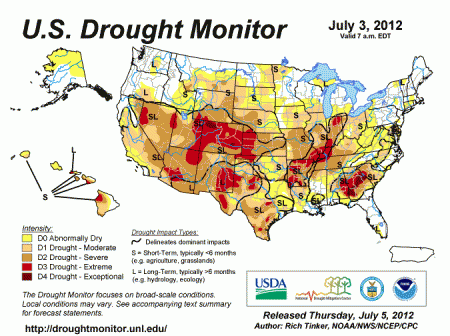
Summer is barely two weeks old and two-thirds of the country is in the grip of a severe drought. More crops will die. More forests will burn. More power brokers will become familiar with the consequences of a derecho. It sounds biblical, but smart scientists have been predicting this very cycle.
In March, the Intergovernmental Panel on Climate Change warned in a special report of "unprecedented extreme weather and climate events" to come. The events are here, though the skeptics now running the Republican Party deny the obvious, in large part because they are paid to deny the obvious.
But for those who are already familiar with the new face of nature, no amount of posturing can wish away the fire this time.
"When you live up here now, it's always a question of when, not if," said Eric Eide, head of the volunteer fire department in Cascade. He's been on duty, without pay, for almost two weeks. A few days ago, when it looked as if all 140 homes of Cascade would burn, Eide's volunteers joined federal firefighters in digging a line and saving the town. It was a daring triage, and heroic. By summer's end, such actions may be routine - the price of living in a new world that we made, but can no longer dominate.

Record High Temperatures across US


The toll from record high temperatures across the United States is mounting. As triple digit temperatures and an intense drought spread, conditions for wildfires continue to get worse, livestock suffers, and corn crops are under threat. Even the mighty Mississippi River is seeing its waters recede.

St. Louis, Milwaukee, Minneapolis and Chicago are just some of the Midwestern cities with record high temperatures this week. In St. Louis, a record high high temperature of 105 was followed up by a record high low temperature of 83. Milwaukee and Madison, Wisconsin also set records with their low temperatures.

The heat wave isn't limited to the Midwest. Here in Washington DC, we're experiencing our record ninth consecutive day over 95 degrees, with at least two more days in the 100′s on the way.

Compounding the issue are massive power outages still seen in parts of the country — a consequence of severe storms that hit last week. In Michigan, around 300,000 residents are still without electricity.

According to NOAA's National Climatic Data Center, over 4,000 daily heat records have been broken in the last 30 days, including 224 all-time heat records. Tomorrow, the expected high in Washington, DC is 106, which would be the highest recorded temperature since 1930.


The heat and associated drought are wreaking havoc on the nation's corn crop. The U.S. is the world's largest producer of corn and 2012 was supposed to be a banner year. Farmers planted 96.4 million acres of corn, a 5 percent increase over last year. But the heat and drought have already caused much of it to shrivel and die. "We're talking five-feet-tall corn with no ears, no shoots and no tassels," said Randy Anderson, a farmer from Illinois. "It wears on your nerves to even look."

Temperatures soared in places like Jefferson County, Missouri, where the high hit 111 and parts of five corn producing states are now suffering from drought conditions. Almost all of Ohio is now officially in drought. Columbus, Ohio had only 2.01 inches of precipitation in June, a full 2 inches below normal — and experts believe that between 5 and 10 inches of rain is necessary to fully end the problems.

As the corn crop now enters a crucial pollination phase, it is even more vulnerable to the heat and lack of rain: "This is a very narrow window for corn, and there's little room for error," said Brad Rippey, an agricultural meteorologist for the United States Department of Agriculture. "Whatever happens in that window, it is what it is — that cob is made or broken."
"This is a moving target," said Darrel L. Good, a professor emeritus of agricultural and consumer economics at the University of Illinois at Urbana-Champaign. "But what we know is this: There's been some permanent and substantive yield reduction already, and we're on the cusp, depending on the weather, of taking that down quite a bit more."
The Mississippi River is also being impacted by the extreme weather conditions. In Vicksburg, Mississippi, the river is 4.79 feet deep, more than 38 feet below its flood stage depth. Some boats, such as the American Queen— one the largest paddle boats ever built — can't access Vicksburg's docks.

According to Robert Latham, the director of Mississippi's Emergency Management Agency, the drought conditions, in conjunction with the lack of northern runoff from melting snow pack due to the mild and dry winter, have contributed to the low water level.
"When you look back at this past winter, one of the things that impacts us is the snow pack and the melt that causes the fluctuation in the river levels," he said. "We didn't have that snow pack that we had over a year ago."
Although this is the time of year when the Mississippi sees its lowest water levels, depths are usually closer to 20 feet.

According to NOAA, El NiƱo conditions may be starting this summer. Though this may bring some much needed immediate relief to much of the country, it sets the stage for even higher temperatures next year.

As drought conditions worsen, climate scientists warn about the role of man-made climate change in intensifying the problem.

Speaking about last year's devastating drought in Texas and Oklahoma, Texas A&M, climate scientist Andrew Dessler said last August that "there is absolutely no way you can conclude that climate change is not playing a role here."  Texas climatologist Katherine Hayhoe also recently explained that "our natural variability is now occurring on top of, and interacting with, background conditions that have already been altered by long-term climate change."

In addition, NASA climatologists, including James Hansen, released peer-reviewed research concluding that the Texas heat wave was "a consequence of global warming because their likelihood was negligible prior to the recent rapid global warming."

Fukushima - A Man Made Disaster

The nuclear accident at Fukushima was a preventable disaster rooted in government-industry collusion and the worst conformist conventions of Japanese culture, a parliamentary inquiry concluded on Thursday.

The report, released by the Fukushima Nuclear Accident Independent Investigation Commission, also warned that the plant may have been damaged by the earthquake on March 11, 2011, even before the arrival of a tsunami — a worrying concern as the quake-prone country starts to bring its reactor fleet back online.

The commission challenged some of the main story lines that the government and the operator of the Fukushima Daiichi Nuclear Power Plant has put forward to explain what went wrong in the early days of the crisis.
"It was a profoundly man-made disaster that could and should have been foreseen and prevented. And its effects could have been mitigated by a more effective human response," Kiyoshi Kurokawa, the commission's chairman and the former head of Tokyo University's Department of Medicine, said in the report's introduction.
But by suggesting that the plant may have sustained extensive damage from the quake — a far more frequent occurrence in Japan — the report in effect casts doubts on the safety of Japan's entire fleet of nuclear plants.

Fires: A Strong Indicator Our Climate is Changing

"We've had record fires in 10 states in the last decade, most of them in the West," said Agriculture Department Undersecretary Harris Sherman, who oversees the Forest Service. 


Over the past 10 years, the wildfire season that normally runs from June to September expanded to include May and October. Once, it was rare to see 5 million cumulative acres burn in a year, but some recent seasons have recorded twice that.

"The climate is changing, and these fires are a very strong indicator of that," Sherman said.

This is what climate change looks like

Millions of people learned a new word last the weekend: "derecho." It was not a happy lesson. [New York Times]


If you want a glimpse of some of the worst of global warming, scientists suggest taking a look at U.S. weather in recent weeks. [Washington Post]


After several years of relatively benign fire seasons, the West is headed into a hot, dry summer of potentially ferocious blazes like the ones that have scorched Colorado in recent weeks. [Los Angeles Times]


July 2, 2012

Colorado Wildfire

Colorado and U.S. Forest Service firefighters are battling the state’s most destructive wildfires ever. Lightning and suspected arson ignited them four weeks ago, but scientists and federal officials say the table was set by a culprit that will probably contribute to bigger and more frequent wildfires for years to come: climate change. [Washington Post]


Firefighters in Colorado Springs struggle to gain control after a forest fire that started west of the city. An AP aerial tour of one neighborhood showed hundreds of heavily damaged or destroyed homes as well as charred forests.